
Meta description: Learn the living within your means meaning, why it matters, and how to build spending habits that create stability, savings, and less money stress.
Some months look fine on paper. Your pay arrives, the bills get paid, and you still end up wondering why your account feels thin long before the next payday.
That's a frustrating place to live. You may be earning what sounds like a decent income, yet groceries, rent, fuel, child costs, subscriptions, and small unplanned purchases keep eating away at your margin. By the end of the month, you're not sure whether you're managing your money or just reacting to it.
If that sounds familiar, you're not failing. A lot of working people feel this pressure. In California, 97% of households struggling to afford basic living expenses include at least one working adult, according to the Real Cost Measure. Employment doesn't automatically create breathing room.
That's why understanding the living within your means meaning matters so much. It isn't about punishment. It isn't about never enjoying your life. It's about getting control over your money so your money stops controlling your month.
Introduction Is This Your Financial Reality
You get paid on Friday. By the next week, the fixed bills are gone from your account. Then come groceries, school costs, a dinner out you didn't plan carefully, a refill at the chemist, a streaming charge you forgot about, and one annoying expense that always seems to show up at the wrong time.
Nothing looks outrageous on its own.
But together, it creates that quiet stress where you start checking your balance more often, delaying purchases, and hoping nothing breaks before payday. If you've read about living paycheck to paycheck, you already know how draining that cycle feels.
The problem is that many people think this is just how adult life works. Earn, pay, stretch, repeat. They assume that if they're employed, they should somehow be able to make everything fit.
Covering your bills and still feeling fragile is a sign that the numbers may be technically working, but the system isn't giving you any room to breathe.
That's where the phrase “living within your means” often gets misunderstood. People hear it as a scolding phrase, as if it only means cutting back or saying no. In practice, it means something much more useful. It means setting up your spending so it matches what your income can support.
Once you understand that properly, you can start making decisions from a place of clarity instead of panic.
What Living Within Your Means Really Means
At the most basic level, living within your means means your spending is less than or equal to your after-tax income. If more money goes out than comes in, you're living beyond your means. If the numbers fit, you're within them.
That's the simple definition. It's also where many people stop.
The more helpful definition adds an important distinction. There is persistent confusion between living within your means and living below your means, where “within” means spending ≤ income and “below” means spending < income with intentional margin, as described in Nationwide's explanation.
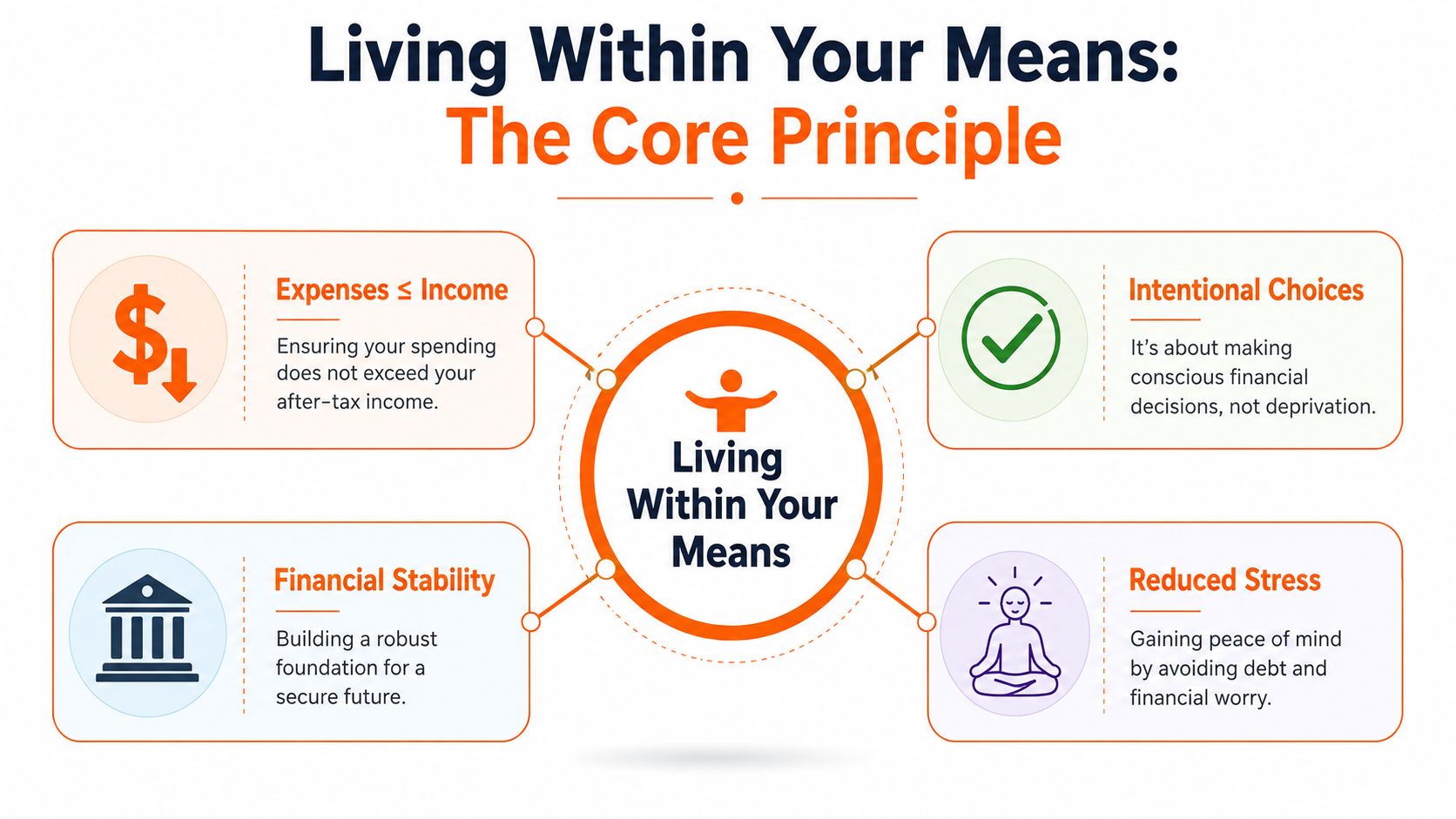
Within versus below
Here's the difference in plain language:
| Approach | What it means in real life |
|---|---|
| Within your means | You cover your expenses, but there may be little or nothing left after bills |
| Below your means | You spend less than you earn on purpose, so there's room for savings, repairs, goals, and surprises |
That small gap matters a lot.
If you spend exactly what you earn every month, you may avoid new debt, but you still don't have much protection. One larger-than-usual expense can knock everything off course. That's why someone can technically live within their means and still feel financially shaky.
Why the phrase confuses people
A lot of readers search for the living within your means meaning because they want more than a dictionary answer. They want to know whether “I pay my bills” is enough. Usually, it isn't.
Practical rule: “Within” is the minimum standard. “Below” is the healthier target.
If you want to build security, you need margin. Margin is what helps you save, handle emergencies, and make progress without relying on luck or credit. If you're new to this, a good companion habit is learning what expense tracking is, because it shows whether you're operating at the edge or with space.
This distinction also removes some shame from the conversation. Many people aren't irresponsible. They're operating with no margin, which feels stable until real life interrupts.
Why This Simple Habit Changes Everything
Living below your means changes more than your budget. It changes how you experience daily life.
When your spending leaves space, bills feel less threatening. An irregular expense doesn't automatically become a crisis. You stop making every decision based on what will get you through the next few days and start thinking about what helps you next month and next year.

It protects you from lifestyle creep
One of the biggest reasons people stay stuck is that spending rises the moment income rises. A pay increase feels like permission to upgrade everything at once.
But living below your means works differently. When household income increases, it's demonstrated by keeping expenses unchanged rather than increasing spending, such as putting the raise into investments instead of lifestyle upgrades, as noted in this Canadian personal finance example on YouTube.
That habit matters because raises don't automatically create wealth. What you do with the raise does.
It gives your goals a real funding source
Most money goals fail for a simple reason. They don't have room in the month.
If all income is already spoken for, then your emergency fund, debt payoff, holiday savings, and retirement contributions are competing with groceries and utilities. They become “important” in theory and underfunded in practice.
A margin fixes that. It gives your priorities a place to live.
- Emergency savings: Money set aside so one surprise doesn't become a debt problem
- Debt reduction: More than the minimum payment, which helps you make actual progress
- Future goals: Home costs, travel, education, retirement, or planned family expenses
If you want a simple way to make this automatic, the pay yourself first method fits naturally here. Save first, then spend what's left. That's often easier than hoping you'll have something remaining at month-end.
5 Signs You Are Living Beyond Your Means
Sometimes the clearest answer doesn't come from a formula. It comes from patterns. If several of these feel familiar, your spending may be outpacing what your income can comfortably support.
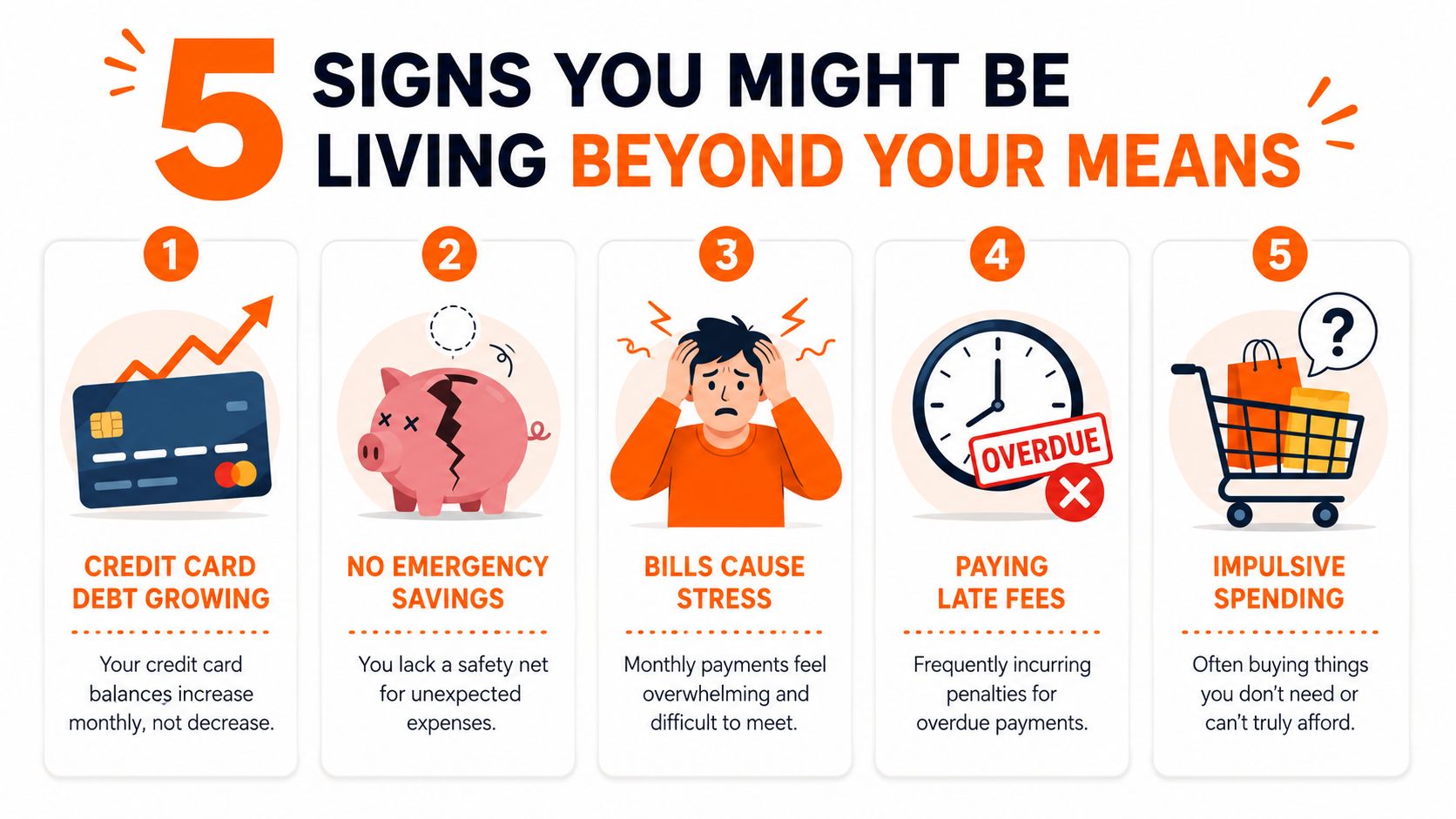
Your debt keeps growing
If your credit card balance rises month after month, that's one of the clearest signs. Credit is filling the gap between your lifestyle and your cash flow.
It can happen slowly. A few groceries here, a school expense there, one online order after a stressful week. Then the balance becomes part of normal life.
You have no real buffer
A person living within their means in the healthiest sense has some room for the unexpected. If every surprise forces a scramble, that usually means the budget is already stretched too tightly.
Many households don't have a spending problem as much as a margin problem.
This is why “I'm covering my bills” can be misleading. Bills aren't the full picture. Real life also includes repairs, gifts, travel, medical costs, and things you didn't see coming.
Bills trigger anxiety every month
Paying rent or a mortgage should require planning. It shouldn't feel like a monthly emergency.
If bill week brings dread, avoidance, or constant account checking, listen to that signal. Stress often shows up before the spreadsheet does.
Minimum payments are your default
Paying only the minimum on debt usually means there isn't enough room in your cash flow to do more. That keeps you stuck in maintenance mode.
You're not getting ahead. You're preserving the status quo.
You don't know where the money went
This one catches many people by surprise. They aren't making wild purchases. They're just losing track of small and medium ones.
A quick self-check helps:
- Can you name your top spending categories? If not, your money may be leaking through habits you haven't seen clearly.
- Do small purchases blend together? Coffee, convenience stops, delivery fees, and digital renewals add up fast.
- Are purchases reactive? Stress, tiredness, and busyness often drive spending more than actual need.
If that last point hits home, a structured reset often helps more than guilt does.
A Practical Plan to Start Living Within Your Means
You don't need a perfect system to begin. You need visibility, a simple plan, and a few decisions you can repeat.

Step 1 See your spending clearly
Start with the last month. Look at every expense, including the small ones people usually ignore.
The Financial Consumer Agency of Canada says living within your means starts by tracking every purchase for a month, including small items like coffee, lottery tickets, and gifts, then using a five-column savings table to identify weekly and monthly savings. Their example includes $15 a week from meal planning and reusable water bottles, which becomes $60 a month toward a $100 monthly cutback goal in their spending guide.
That advice is useful because it's concrete. Most budgets fail when they only focus on the obvious bills and ignore the drift.
Try sorting your spending into broad groups first:
- Fixed costs: Rent, mortgage, insurance, childcare, loan payments
- Flexible essentials: Groceries, transport, household basics
- Lifestyle spending: Eating out, shopping, entertainment, app purchases
- Irregular costs: Gifts, annual renewals, repairs, school extras
If you want help with this stage, one option is Fintrack's expense tracking feature, which lets you categorise spending and review transactions without relying only on memory.
Step 2 Compare income and outflow honestly
Next, put your take-home income beside your monthly spending. Not your hoped-for spending. The actual figure.
If spending is higher, you've found the problem. If spending is equal, you're at the edge. If spending is lower, you've created the start of a margin.
A few questions make this easier:
| Question | What the answer tells you |
|---|---|
| Do I have money left after essentials and regular spending? | Whether you have margin or are operating at your limit |
| Which categories surprise me? | Where habits may be draining cash quietly |
| What expenses feel non-negotiable but might still be adjustable? | Where meaningful changes may be possible |
This step can feel uncomfortable. That's normal. Clear numbers are better than vague stress.
Step 3 Build a simple spending plan
A budget is just a plan for your money before the month happens. It isn't a punishment system.
Keep it simple. Cover essentials first. Add realistic amounts for daily life. Then assign money to savings or debt reduction before filling in extra wants. If you need a place to begin, a monthly budget template can help you organise the categories without overthinking the format.
A good budget is not the strictest one. It's the one you can follow when life gets busy.
If you're looking for more general habits that support this process, Lein Law Offices' guide to avoiding debt offers a practical overview of debt-prevention behaviours that fit well with a basic spending plan.
Step 4 Use the 90 percent rule
A useful tactic is to budget based on only 90% of your income, rather than the full amount. Cambridge Credit explains that this approach creates an automatic 10% savings buffer, and notes that saving 10% of income is a key sign of financial health in their article on living within your means.
Here's why it works. If you mentally treat all of your income as spendable, your lifestyle tends to expand to match it. If you only budget from part of it, you create protection before impulse and routine can absorb the rest.
This won't be realistic for everyone immediately. If your current expenses already exceed income, start smaller. The idea is to build intentional margin, not to force an impossible plan.
Step 5 Keep your lifestyle steady when income changes
When your pay rises, don't rush to raise your fixed costs with it. Pause first.
That doesn't mean you can never upgrade anything. It means you should decide deliberately. Directing new income toward savings, debt reduction, or long-term goals is what turns a higher income into stronger finances.
Step 6 Review and adjust every month
Your “means” are not static. Costs change, work changes, family needs change.
That's why living within your means isn't one decision you make once. It's a monthly habit of checking whether your spending still matches reality. If it doesn't, adjust early. Small course corrections are easier than financial clean-up later.
Your First Step Toward Financial Clarity
The meaning of living within your means is simple. Spend in a way your income can support, and aim for enough margin that normal life doesn't knock you over.
That's the part many people miss. Living within your means may stop the bleeding. Living below your means is what starts building stability.
You don't need to fix everything this week. Start by seeing the truth of your numbers. Track what you spend, compare it with what you bring home, and make one adjustment that gives you a little more room than you had before. If you want a broader view of how your money fits together, a personal finance dashboard can help you stay organised and spot patterns faster.
If you want a simple next step, Fintrack can help you review spending, organise categories, and see where your money is going so you can make decisions with more clarity.