
Payday arrives, the automatic bills clear, and the balance looks healthy for a moment. By the third week, though, groceries, transport, small online purchases, and one unexpected bill have squeezed the account again. Nothing looks dramatic on its own, yet the month still ends with the same question: where did the money go?
That pattern usually points to a missing system, not a personal failure. Strong money management skills are practical behaviours you can run on ordinary days, especially when income feels tight. This guide focuses on four: building a usable budget, controlling cash flow, recovering money that's being wasted or overlooked, and saving toward defined goals.
You'll also get daily, weekly, and monthly routines, along with simple measures that show whether the system is working. The point isn't to track every purchase forever. It's to make the next decision clearer, so your paycheque supports your priorities instead of disappearing before the month ends.
When Your Paycheque Disappears Before the Month Ends
Jordan gets paid on Friday. Rent and utilities leave the account automatically, a credit-card payment follows, and a few subscriptions renew over the weekend. Jordan buys groceries, fills the car, accepts a couple of takeaway orders during a busy week, and pays for a friend's birthday dinner.
By the twentieth, there's no single mistake to point to. The money moved without a plan for the order in which it needed to be used. Jordan isn't careless. Jordan is missing a repeatable way to see upcoming obligations, daily spending, and future needs together.
That distinction matters. Telling yourself to “be better with money” creates pressure but no operating method. A budget, by contrast, gives each dollar a job before the month gets noisy.
Practical rule: If you can't explain what your next paycheque needs to cover, you're managing a balance, not your cash flow.
The problem is widespread enough that Canadian data makes budgeting a useful starting point. The Financial Consumer Agency of Canada reports that only 46% of Canadians had a budget, while 93% of those budgeters stayed within it. In a separate 2024 Canadian Financial Capability Survey, about 55% of Canadians had a household budget, leaving a substantial share without a basic spending framework. The FCAC progress report connects budgeting with payment discipline and continued financial commitments.
This article treats money management as a small system:
- Budgeting: Decide what each category can support.
- Cash-flow control: Time income, bills, spending, and reserves so one surprise doesn't derail the month.
- Recovery: Find subscriptions, rewards, credits, and charges that can be reclaimed or stopped.
- Goal-directed saving: Turn a vague intention into a named target with a transfer and review date.
If you're often ending the month short, start with this guide to living paycheck to paycheck. The solution isn't a stricter personality. It's a system you can run.
The Core Money Management Skills You Need to Build
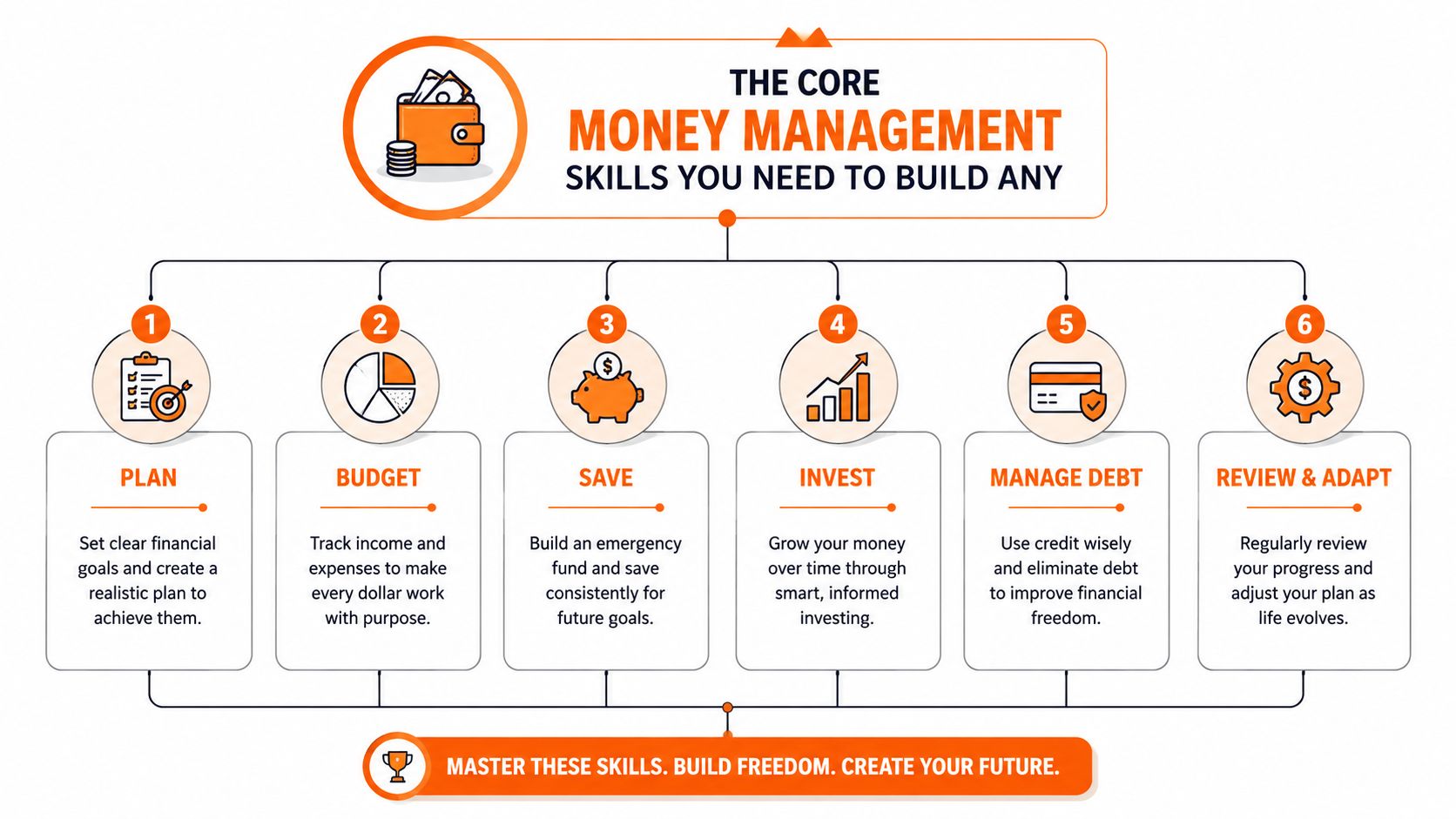
Money management isn't one habit. It's a chain of decisions, and each link does a different job.
Budgeting sets the boundaries. It answers, “What can I spend in this category?” A budget becomes useful when it reflects real bills, irregular costs, and the spending choices you make repeatedly, not when it looks tidy in a spreadsheet.
Cash-flow control handles timing. Even a balanced monthly plan can fail if rent leaves before income arrives, annual insurance isn't reserved, or a large bill lands during an expensive week. Cash-flow control means watching the calendar as well as the categories.
Waste and rewards recovery looks backward and asks what can be stopped or reclaimed. Forgotten subscriptions, duplicate charges, unused credits, and unclaimed loyalty value all deserve attention because they affect cash without requiring a higher income.
Goal-directed saving gives surplus a destination. “Save more” is too vague to guide a decision at the checkout. A named emergency reserve, travel fund, or debt target makes the trade-off visible.
The skill most people confuse with tracking
Tracking is only useful when it changes what you do next. A list of transactions won't help if you keep the same spending limits, ignore recurring charges, or postpone saving until the end of the month.
The weak point is usually the feedback loop. You need to compare the plan with actual spending, decide what needs adjusting, and make the adjustment while there's still time to affect the month. A practical cash flow management guide can help if your main difficulty is coordinating inflows, bills, and reserves rather than identifying expenses.
These skills build on one another. Savings goals depend on recovered cash and controlled spending. Cash-flow decisions depend on a budget that reflects reality. The whole system improves only when you review what happened and act on it.
For a broader foundation, use this personal finance planning guide. Then put the ideas into a routine that tells you what to check today, this week, and at month-end.
Build Your First Budget the Canadian Way
Start with after-tax income, not your salary before deductions. A widely used Canadian framework assigns 50% to needs, 30% to wants, and 20% to savings or extra debt repayment, as outlined in this Canadian 50/30/20 budgeting guide.
The percentages are a starting structure, not a moral test. If housing consumes more than the needs allocation, record the gap accurately instead of forcing your life into a neat formula.
Make the framework concrete
Suppose your monthly net income is $4,000. A 50/30/20 plan would set aside:
- Needs: $2,000 for rent or mortgage, groceries, utilities, transport, required insurance, and minimum debt payments.
- Wants: $1,200 for dining out, streaming, travel, hobbies, and other optional spending.
- Savings or extra debt repayment: $800 for an emergency reserve, a sinking fund, or payments above the minimum.
Now turn those buckets into actual categories. A needs section might include $1,500 for rent, $350 for groceries, $100 for transit, and $50 for phone service. A wants section might include $35 for a streaming bundle and room for discretionary purchases. If car insurance is paid annually, create a sinking fund instead of pretending the bill doesn't exist during ordinary months.
A budget becomes honest when its categories reflect the timing and amount of real obligations, including costs that don't arrive every month.
Set it up and review it
Create category limits in Fintrack's Budget Planning feature, then compare those limits with actual spending as transactions arrive. You can also use a conversational assistant to ask a plain-language question such as, “How much did I spend on food this month?” Fintrack supports manual entry without requiring a bank connection, which can suit Canadians who prefer not to connect financial accounts.

During week one, watch three categories:
- Groceries, because frequent small trips can distort the plan.
- Transport, because fuel, rideshares, and parking often arrive separately.
- Wants, because optional spending is easiest to adjust before it crowds out savings.
Spend a minute checking the budget view before a non-essential purchase. For a ready-made structure, adapt this monthly budget template, then change the categories to match your household.
Protect Cash Flow and Build Your Emergency Buffer
A budget tells you what should happen. Cash-flow control prepares you for what happens when income is delayed or an essential cost jumps.
The Financial Consumer Agency of Canada recommends an emergency fund covering three to six months of living expenses. The target should be based on essential spending, not total income. If your necessary monthly costs include housing, food, utilities, transport, and minimum debt payments, use that total as the base for the reserve.
Build the reserve in a fixed sequence
- Choose the target. Calculate your essential monthly cost, then define the reserve range that fits your situation.
- Choose the date. Give the fund a finish point, even if you'll revise it later.
- Choose the frequency. Set a fixed transfer on each payday or another reliable income date.
- Separate the money. Keep the reserve away from your everyday spending account.
- Review progress. Check whether the transfer happened before deciding what discretionary money remains.
The FCAC recommends choosing a savings amount, date, and frequency, then automating the transfer from your regular account on paydays. Its emergency fund guidance also stresses separating needs from wants before redirecting expenses.
Use Budget Planning to give the reserve its own category and progress target. The system works better when you can see the next contribution and the remaining gap, rather than holding an abstract intention in your head.
Stress-test the month
Take three realistic disruptions and decide what happens before they arrive:
- A pay period is missed.
- A necessary car repair appears.
- A winter utility bill is higher than expected.
The buffer should absorb the essential shock, while the budget identifies which optional categories pause first. Don't use the reserve for routine overspending, but don't make the fund so difficult to access that you reach for expensive credit during a genuine emergency.
Canadian households remain vulnerable to job loss or unexpected expenses while household indebtedness stays high relative to income, according to the Bank of Canada's household financial stability analysis. For households carrying variable-rate debt or lines of credit, cash-flow planning matters more than cutting a few small expenses.
Property owners and landlords may also need a separate view of income, expenses, and reserves. A cash-flow calculator guide for local real estate investors can help organise that kind of property-level planning without mixing it into the household essentials budget.
For the immediate next step, use this emergency fund building guide to choose the amount, date, and transfer you'll maintain.
Spot Subscriptions, Recover Rewards, and Stop the Bleed
The easiest money to recover is often money you already agreed to spend. That makes recurring charges and unused benefits a separate money management skill, not a minor clean-up task.
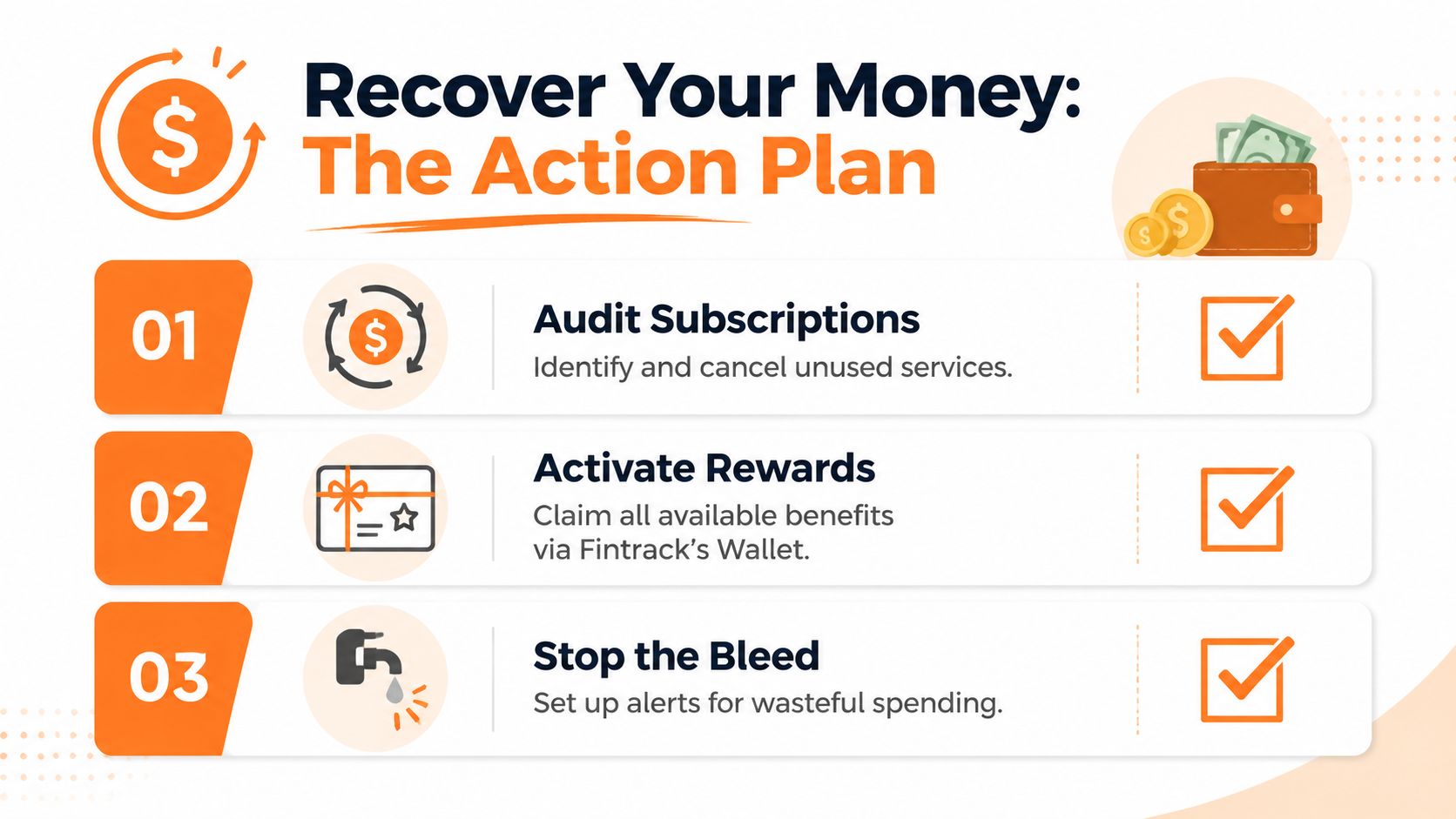
Start with a monthly audit. Look for services you no longer use, duplicate subscriptions billed through different platforms, annual renewals you forgot to plan for, and credits or points approaching expiry. Don't cancel a service only because it appears in a list. Check whether it supports a real need, then make a deliberate keep, downgrade, cancel, or redeem decision.
Use a short recovery checklist
- Recurring charges: Identify every subscription and write down the last time you used it.
- Unused value: Check travel credits, loyalty points, cashback, discounts, and other benefits before they expire.
- Duplicate payments: Compare similar charges and investigate anything that appears twice.
- Unusual activity: Review alerts promptly instead of waiting for the monthly statement.
- Decision record: Mark what you cancelled, redeemed, disputed, or kept, so you don't repeat the review from scratch.
Fintrack's Benefits Wallet can surface forgotten subscriptions, unused credits, loyalty points, discounts, and expiring offers. Its transaction tools can also categorise spending and flag unusual activity or duplicate charges. If subscriptions are your main leak, follow this practical subscription management guide.
Track recovered dollars, not just cancellations
Suppose someone cancels two unused streaming services, claims a forgotten travel credit, and redeems a small cashback offer in one afternoon. The useful result isn't the number of cancellations. It's the total value recovered and whether that value goes toward a defined purpose instead of disappearing into new spending.
Record recovered money as its own metric. You might direct it to the emergency reserve, an annual bill, or extra debt repayment. That decision turns a one-time clean-up into a repeatable cycle.
Set aside a recurring review slot and keep it short. The point isn't to become obsessed with every transaction. It's to make sure your money doesn't continue leaving through charges you no longer value or benefits you never claim.
Daily, Weekly, and Monthly Routines That Make the Skills Stick
Money management skills become reliable when the review is small enough to repeat. You don't need a long financial meeting every day. You need the right question at the right interval.
The daily check
Spend two minutes on three items:
- Budget view: Check the categories most likely to run ahead.
- Alerts: Triage unusual, duplicate, or unexpected transactions.
- Next purchase: Decide whether a non-essential expense fits the remaining plan.
This routine is intentionally brief. It keeps awareness close to the decision instead of forcing you to reconstruct the month after the balance has already tightened.
The weekly review
Set aside fifteen minutes once a week. Compare actual spending with the plan, cancel or pause one waste item, and move available surplus toward the emergency buffer or a current goal. If a category is consistently unrealistic, adjust the limit and identify the behaviour causing the mismatch.
Track three measures:
- Budget adherence rate: How often did spending remain within the category plan?
- Monthly recovered dollars: How much value came back from cancelled services, credits, rewards, or corrected charges?
- Buffer months covered: How many months of essential expenses could the reserve support?
These measures are more useful than judging yourself by whether the month felt disciplined. They show whether the system is producing the outcomes you need.
The monthly close
Use thirty minutes at month-end to rebalance categories, top up sinking funds, review debt-service pressure, and compare progress with your goals. Keep goals specific enough to guide a transfer, such as an emergency reserve or a planned annual expense.
A budgeting framework can also support shared money. If a partner or roommate contributes to household bills, agree on who owns each category, when shared expenses are reviewed, and how changes are recorded. Household planning tools can keep individual spending separate from shared obligations.
For Canadians managing debt, the Bank of Canada rate environment is a reminder to monitor borrowing costs rather than treating every balance as interchangeable. As of July 15, 2026, the Bank of Canada's policy interest rate was 2.25%, while the posted prime rate at major banks was 4.45%, according to the Bank of Canada. Statistics Canada recorded secured personal lines of credit at 4.01% in January 2026, rising to 4.18% in April before reaching 4.04% in May, as shown in its consumer credit table. Your routine should include balances, rates, and payments, not only spending categories.
Common Pitfalls and Your Next Step
A system can still fail if you use it to confirm intentions instead of make decisions. Watch for these traps.
Lifestyle creep begins when a raise, bonus, or lower bill becomes permission for permanent spending. Assign new income before it arrives in your account. Direct part of it to a named goal or reserve, then decide what remains available for lifestyle upgrades.
Vague goals create vague behaviour. “Build savings” doesn't tell you how much to transfer or when to review progress. Name the purpose, choose a target based on the expense, and schedule the contribution on payday.
App neglect is another common failure. Opening a budgeting tool once doesn't create a habit, and reviewing only after money is gone turns the process into a post-mortem. Put the daily check beside an existing routine, such as morning coffee or the evening phone charge.
Overly rigid categories can also undermine the plan. A budget that leaves no room for ordinary enjoyment encourages a rebound. Keep the structure firm around essentials, debt obligations, and savings, but make discretionary spending visible and intentional.
Useful test: A money skill is working when it changes a decision before the money leaves.
Canadian evidence also argues against treating financial education as an abstract classroom exercise. In June 2025, 92% of Canadians said financial literacy was lacking in high schools, and 95% said young Canadians needed more support, while only 9% of Canadian parents strongly agreed their child was well prepared to manage money independently after leaving home, according to the FCAC financial literacy strategy. Practical routines should start before financial habits become difficult to change.
Your next move is simple. Open a budget planner, create the first version of a 50/30/20 plan, add your real needs and recurring charges, and choose one category to review this week. A finished first draft will teach you more than another month of good intentions.
Fintrack brings budgets, expenses, goals, alerts, and money-recovery checks into one view, with manual entry available when you don't want to connect a bank account. Visit Fintrack to build your first budget and turn these money management skills into a routine you can maintain.