
You check your investment account on a Sunday afternoon. The balance is higher than it was a few months ago, which feels reassuring. Then the doubt shows up. Is that growth good, or is your money just drifting upward without much direction?
That question matters more than is often realised. A bigger balance doesn’t automatically mean you’re making strong progress. If one option grows slowly, another grows faster, and a third only looks good until you factor in time, inflation, or taxes, the number in your account by itself won’t tell you much.
The tool that brings clarity is rate of return. It helps you measure performance in a way you can compare, track, and use for real decisions. Once you understand it, you stop guessing whether your money is working hard enough.
Is Your Money Actually Working for You?
A lot of people run into the same problem. They can tell whether their account went up or down, but they can’t tell whether the result is meaningful.
Say you put money into an investment, leave it alone, and come back later to see a gain. That’s encouraging. But you still don’t know whether the result was strong for the time period, whether inflation ate into it, or whether another option would have done the job better.
That’s where rate of return becomes useful. It gives you a common language for measuring progress. Instead of saying, “My account is up,” you can say, “My investment earned this percentage over this period.”
Why people get stuck
Most confusion comes from mixing up growth with performance.
If your balance rises, that’s growth. But performance asks a sharper question: how much did your money earn relative to what you put in, and over what period of time?
That distinction is why two people can both make money and still have very different outcomes. One may have earned a solid return efficiently. The other may have tied up money for years for a weaker result.
A rate of return is less about celebration and more about comparison.
It also helps with everyday financial planning. You can use it to compare investing with paying down debt, holding cash, or putting extra money into registered accounts. The same kind of thinking matters in other areas of personal finance too. For example, if you’re trying to understand how tax-advantaged accounts work, this explainer on what an HSA account is shows how account structure can affect what you keep.
What this means for you
When you know your rate of return, you can answer practical questions like:
- Is this investment doing enough? You’re no longer relying on a vague feeling.
- Am I on track for a goal? A percentage is easier to compare with a target than a raw dollar increase.
- Should I change course? Weak results may point to high fees, poor timing, or the wrong account type.
This isn’t advanced finance. It’s a basic measuring tool, like checking pace during a run. You don’t need to be an expert to use it well. You just need to know what the number is telling you.
What Is a Rate of Return
Rate of return refers to how much you gained or lost on an investment, expressed as a percentage of what you started with.
Think of it as a report card for your money. You put in an amount at the start, you look at what you have at the end, and you measure the difference in percentage terms. That percentage is what makes different outcomes easier to compare.
The simple version
The most basic form is the simple rate of return:
(Ending Value - Beginning Value) / Beginning Value
If you invest money and later your investment is worth more, the difference is your gain. Divide that gain by your starting amount, and you get the return as a decimal. Convert it to a percentage, and you have your simple rate of return.
This works well for a quick snapshot. It’s easy to calculate and easy to understand.
A plain-language example
Picture baking a cake. Your ingredients are your starting investment. The finished cake is the value you end up with. If the finished result is bigger than what you started with, you produced a gain.
That’s why percentage matters. A gain only tells part of the story. The percentage tells you how efficient the result was relative to the amount you committed.
If you also invest in property, the same logic applies there. This guide for real estate investors on ROI is helpful because it shows how return measures can shape decisions in a completely different asset class.
Practical rule: Always ask “return on what?” A gain means little until you compare it with the amount invested.
Why this basic formula still matters
Even though simple rate of return has limits, it’s still the starting point for understanding performance. It teaches you to stop looking only at dollar gains and start thinking in percentages.
That shift changes how you evaluate almost everything. It also fits into the bigger picture of financial planning, because investment decisions don’t sit on their own. They connect to cash flow, savings priorities, and long-term goals. This broader article on planning personal finance is useful if you want to place return in the context of your whole money plan.
Beyond the Basics Key Rate of Return Variants
Simple rate of return is useful, but it doesn’t solve every problem. If two investments were held for different lengths of time, a straight percentage can give a distorted comparison.
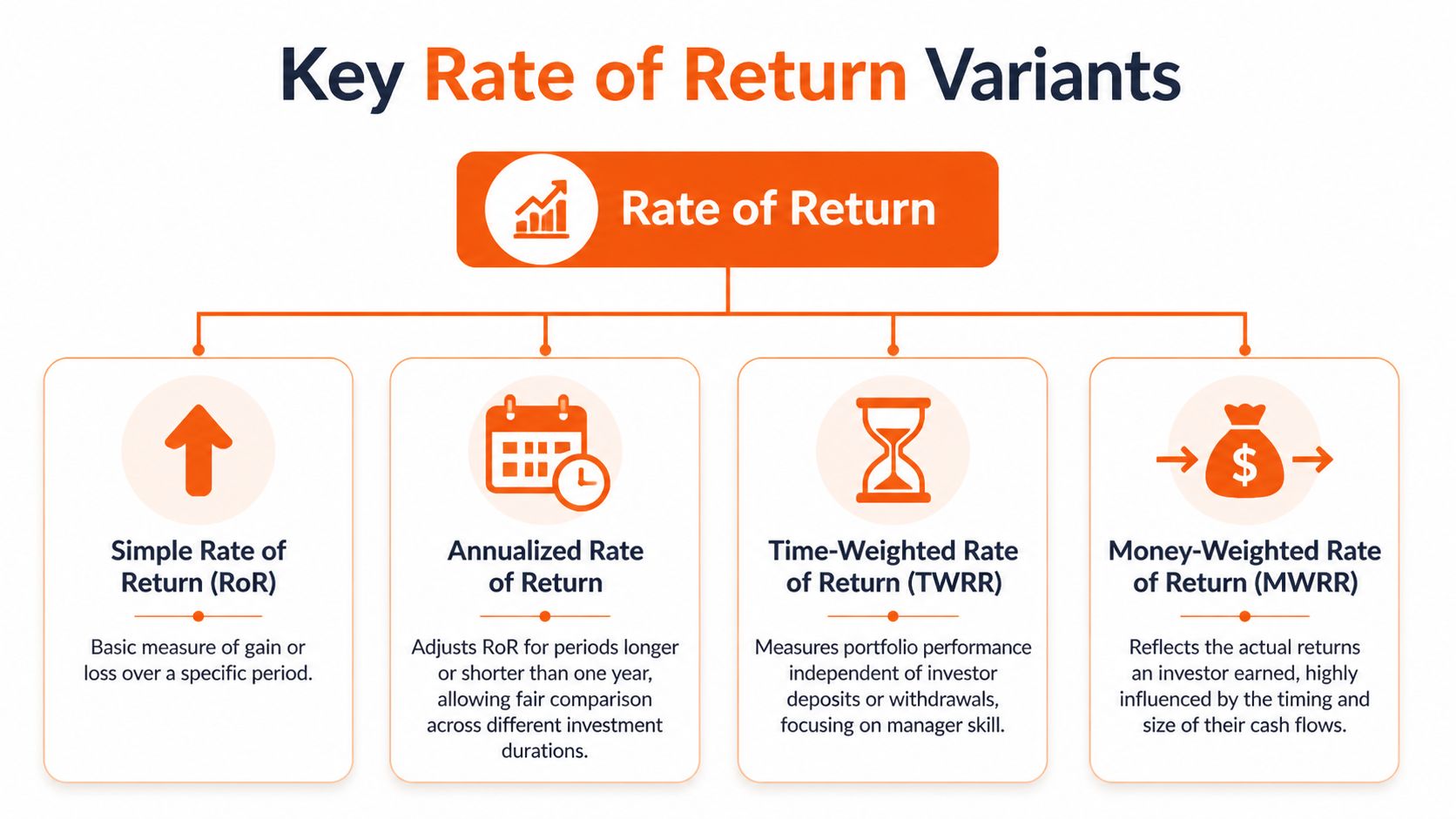
That’s why investors use a few related versions of rate of return. Each answers a slightly different question.
Annualized rate of return
If one investment earned a total gain over several years, you usually want to know what that worked out to per year. That’s what annualized rate of return does.
The annualized formula is Ra = [(Ve / Vb)^(1/n) - 1] × 100, which adjusts simple returns for the holding period. A verified example shows that a $10,000 TFSA investment growing to $14,000 over 5 years has an annualized rate of return of about 7.0%, which is more informative than calling it a simple 40% return overall, according to this annualized RoR formula example.
Why does this matter? Because “up 40%” sounds dramatic, but spread over several years it may reflect a moderate yearly pace rather than an outstanding one.
Nominal and real rate of return
Another common source of confusion is the difference between nominal and real return.
- Nominal return is the raw return before inflation.
- Real return adjusts for inflation and shows what happened to your purchasing power.
If your money grew, but prices also rose, your spending power may have improved less than the headline number suggests. Real return helps correct that.
A return only counts as real progress if it improves what your money can actually buy.
Time-weighted and money-weighted return
You may also hear about two portfolio-level measures:
| Type | What it focuses on | Best use |
|---|---|---|
| Time-weighted return | Investment performance with less emphasis on deposits and withdrawals | Comparing manager or portfolio performance |
| Money-weighted return | Your actual result, influenced by when you added or removed money | Measuring your personal investing experience |
This matters if you make regular contributions or withdrawals. Two investors can hold the same investments and still end up with different money-weighted outcomes because their timing differed.
When to use which version
A quick rule of thumb helps:
- Use simple return for a rough snapshot.
- Use annualized return when comparing different holding periods.
- Use real return when inflation matters, which is most of the time in long-term planning.
- Use money-weighted return if you want to know how your own deposit timing affected results.
Once you know which question you’re asking, the right version becomes much easier to choose.
How to Calculate Your Rate of Return Step by Step
A formula feels much less intimidating when you walk through it once with real numbers. The process is straightforward if you go in order.
A simple calculation flow
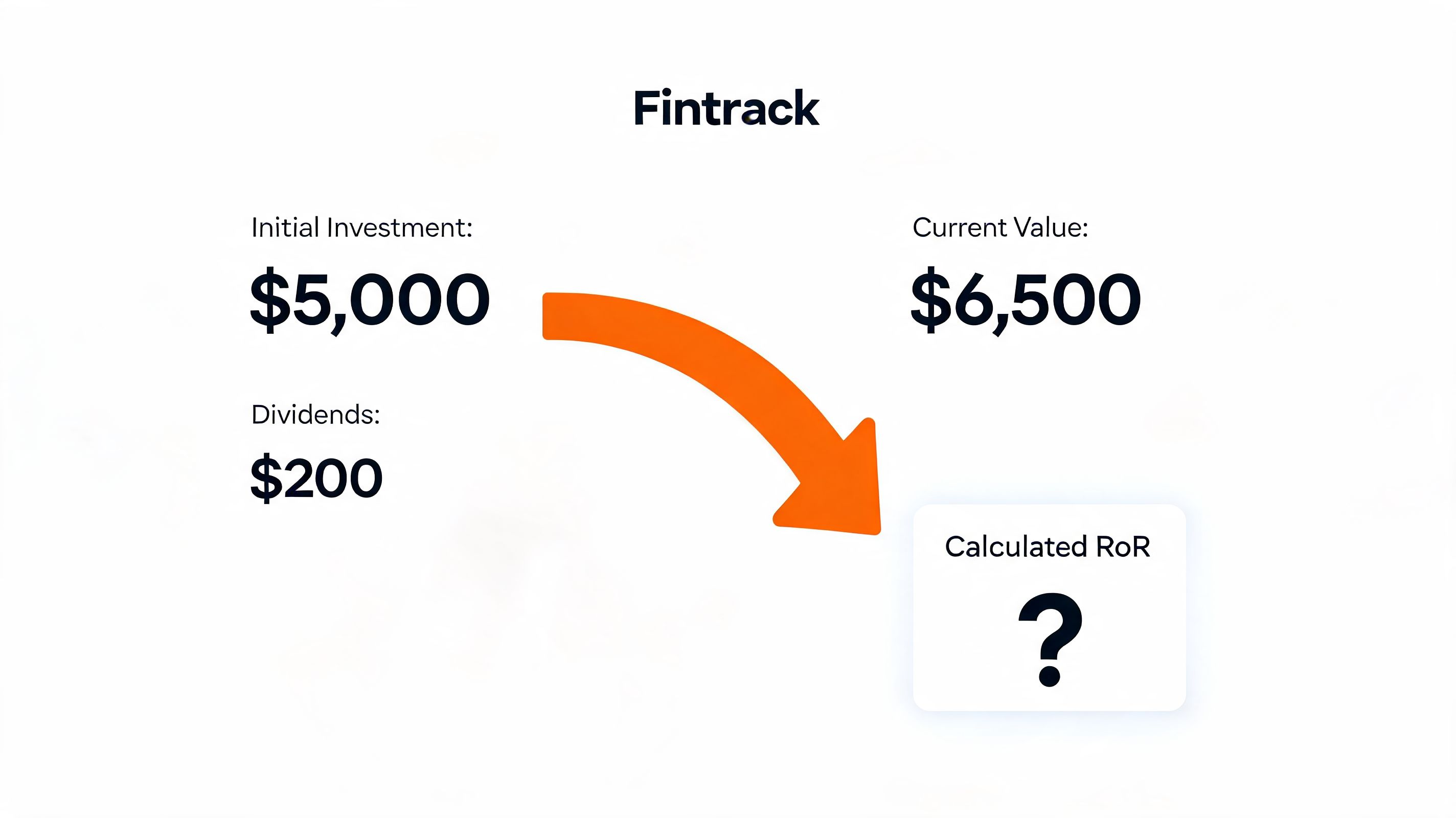
Suppose you invested in an ETF several years ago. To calculate your annualized rate of return, gather three things:
- Your starting value
- Your ending value
- How long you held the investment
If the investment paid income along the way, such as dividends, include that in the total value you received.
The step-by-step method
Find your total gain
Subtract what you started with from the value you ended up with, including any income paid to you.Calculate the total return
Divide that gain by your original investment.Annualize it if needed
If the investment was held for more than one year, use the annualized formula instead of stopping at the total percentage.Convert to a percentage
Multiply the decimal by one hundred so the result is easier to read.
That’s it. The calculation isn’t the hard part. The hard part is remembering to include all parts of the return and to match the formula to the question you’re asking.
Two things people often miss
People usually make errors in one of these places:
- Income payments: Dividends and similar payouts count toward return.
- Time: A multi-year result should usually be annualized.
If you want to get more comfortable with the income side of investing, this article on how to calculate dividend yield helps because yield and return often get mixed up, even though they measure different things.
If cash came out of the investment and into your pocket, it still counts as part of the outcome.
For readers who compare returns in other financial settings, this breakdown of understanding prop firm profit splits is another useful example of how headline earnings can differ from what you ultimately keep.
Keep the process practical
You don’t need to calculate this every day. A periodic review is usually enough.
The goal isn’t to become obsessed with performance. The goal is to create a repeatable way to judge whether an investment is helping you move toward your larger plan.
Common Mistakes When Using Rate of Return
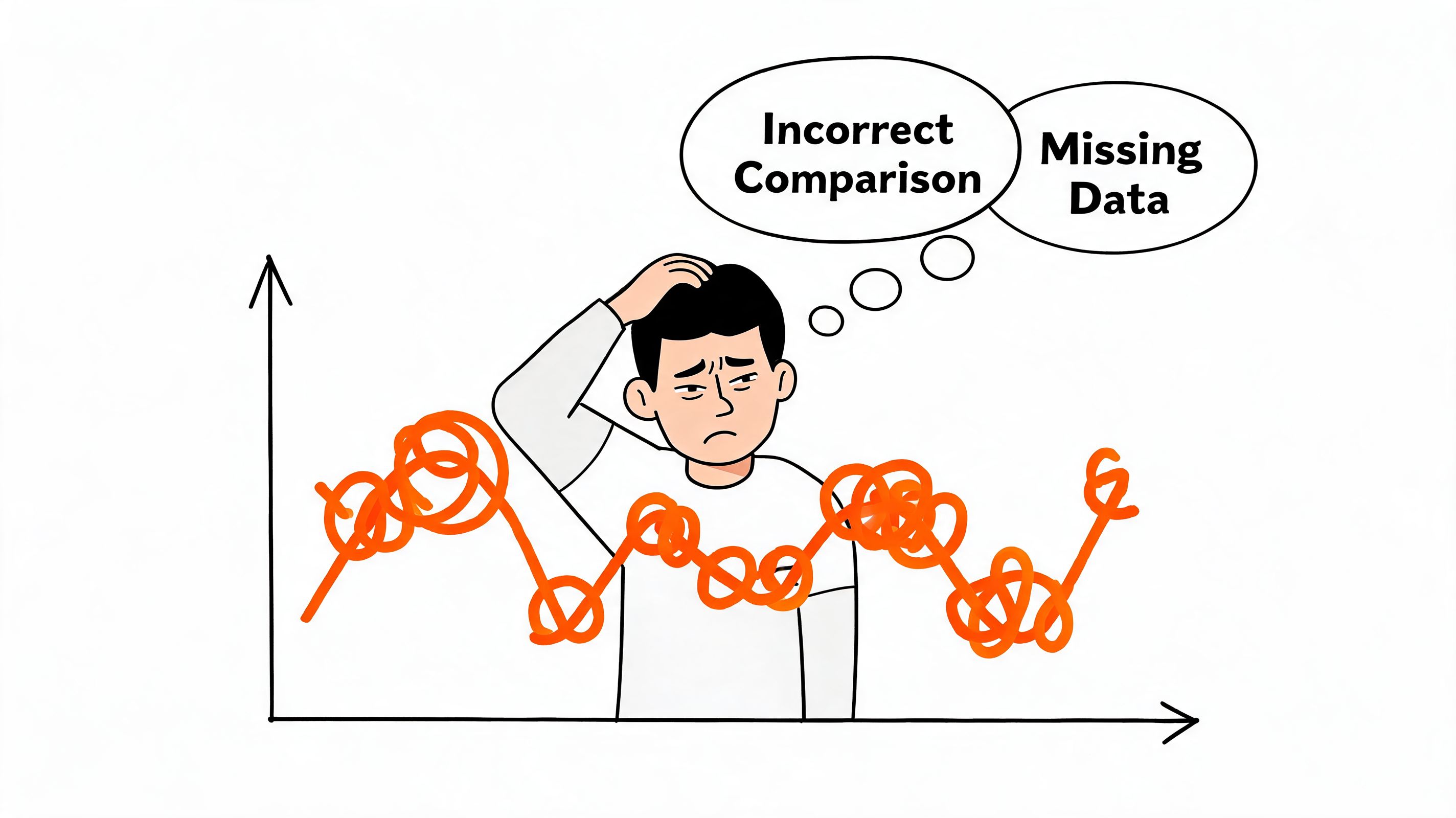
Most mistakes with rate of return don’t come from bad math. They come from leaving out parts of the story.
A return number can look strong on paper and still be disappointing in real life. That usually happens when people focus on the visible gain and ignore the costs, the tax impact, or the effect of rising prices.
The biggest errors
Ignoring inflation
A positive return doesn’t automatically mean your purchasing power improved. If prices rose quickly, part of your gain may have been cancelled out.Forgetting taxes
In non-registered accounts, what matters is not just what you earned, but what you keep after tax.Stopping at simple return
A total gain over several years can sound better than it really is when you don’t annualize it.Overlooking fees
Management fees, trading costs, and other charges reduce your net result.
A Canada-specific example
In Canada, tax and inflation can materially change the picture. A verified example shows that in Ontario, a 7% nominal equity return can shrink to a 4.2% after-tax real rate of return after accounting for tax and a 2.8% CPI, and a 2024 OSC investor survey found that 68% of professionals overestimate their rate of return by 3-5% by missing this adjustment, according to this Canadian tax and inflation RoR example.
That’s a good reminder that the first number you see is rarely the final number that matters.
A better way to read your returns
Use this short checklist when reviewing any investment result:
Ask what period the number covers
If it spans multiple years, annualize it before comparing it with anything else.Check whether it’s before or after fees
Your return is the amount left after costs, not the amount advertised.Separate nominal from real
If inflation was meaningful, nominal return can overstate progress.Match the account type
Registered and non-registered accounts can produce very different after-tax outcomes.
The most useful return figure is the one that survives contact with taxes, fees, and inflation.
This mindset also helps with debt decisions. If you’re weighing investing against guaranteed savings from reducing interest costs, this piece on paying off your mortgage loan early is a good complement because it frames returns through the lens of trade-offs, not just market gains.
Using RoR to Make Smarter Money Decisions
Once you understand rate of return, it becomes a decision tool rather than a statistic you glance at and forget.
One of the best uses is benchmarking. A verified long-term reference point is the S&P 500’s historical average annual rate of return of 9.349% over the last 150 years with dividends reinvested, and 6.938% after inflation, according to this long-term S&P 500 return benchmark. That doesn’t mean your portfolio should match it exactly. It does mean you have a widely used yardstick for thinking about long-term equity returns.
How to use rate of return in everyday planning
A practical approach looks like this:
Compare your result with an appropriate benchmark
A cash account, a balanced fund, and an all-equity index fund shouldn’t be judged by the same standard.Tie return to a goal
If a goal depends on growth over time, your annualized return helps you judge whether the current path is good enough.Review weak spots
If returns lag your expectations, the cause may be fees, overconcentration, too much idle cash, or frequent changes in strategy.
Turn the number into action
Rate of return is most helpful when it changes behaviour.
It can help you decide whether to keep contributing to the same investment, rebalance, simplify accounts, or lower costs. It can also help you spot a hidden win. For example, employer matching in a retirement plan can create an unusually attractive outcome, which is why this article on what RRSP matching means is worth reading as part of the same conversation.
If you want one place to track goals, cash flow, and account progress together, Fintrack can help you apply this thinking in practice through its Strategies & Goals view and broader financial overview tools. Used that way, rate of return stops being abstract and starts becoming part of regular decision-making.
Don’t ask only whether an investment made money. Ask whether it helped you move closer to the life that money is for.
If you want to put this into practice, Fintrack gives you a clearer view of your accounts, goals, and overall money plan so you can review progress with more context and less guesswork.