
When you empty your coat pocket, you find a few coins, maybe a note you forgot about, and some change from a quick shop run. Most of the time, that money drifts right back out again. It covers a snack, disappears into another errand, or gets mixed into your wallet until you stop noticing it.
A save money box gives that loose cash a job.
For adults, this isn't about using a child's piggy bank. It's about using a simple physical cue to build a savings habit you can see. When money moves out of your spending space and into a dedicated place, saving stops feeling abstract. It becomes a small action you repeat.
Why a Simple Box Is Still a Powerful Savings Tool

You get home, empty your pockets, and notice £6 in coins and a stray note. That money is too small to feel like real savings, but it is also easy to spend without thinking. A save money box changes that moment. It turns loose cash into a visible decision.
The save money box endures because it uses basic human psychology to make saving tangible. Money boxes have been around for centuries, including early examples traced back to the 2nd century BC, as noted in this history of the piggy bank. The idea has lasted for a simple reason. People save more consistently when the habit is easy to see and easy to repeat.
For adults, that makes the box more than a childhood object. It works like a speed bump between impulse spending and intentional saving. Your banking app may hold your actual balance, but the box handles the behaviour that gets money there in the first place.
Why physical saving feels different
Physical saving changes the feel of money.
Cash in your wallet still feels available. Cash in a labeled box feels spoken for. That mental shift is small, but it matters because people often spend based on what feels unused, not only on what a budget says.
A save money box helps in three practical ways:
- It makes progress visible. You can hear coins drop, see notes stack up, and notice that the box is getting heavier.
- It adds a pause before spending. Opening a box and taking money out is slower and more deliberate than tapping a card.
- It strengthens the habit loop. Deposit, notice, repeat. The routine itself becomes the system.
A good comparison is a kitchen fruit bowl. If fruit is visible, you are more likely to eat it. If savings are visible, you are more likely to add to them. What sits in front of you shapes what you do next.
This is also where adults can connect an old-fashioned habit to modern money management. The box holds the physical trigger. A notes app, spreadsheet, or savings tracker records the amount and ties it to a larger goal, such as a car repair fund or holiday budget. The physical box builds consistency. The digital record keeps the habit accurate and serious.
For readers who want ideas for turning small deposits into a repeatable system, this saving money challenge guide shows how to track progress without losing the simplicity that makes the method work.
Setting Up Your Save Money Box for Success
A save money box works best when it feels purposeful the moment you see it. If loose cash is mixed with receipts, charger cables, and random clutter, your brain reads it as spare money. If the same cash sits in a named container with a clear job, it starts to feel assigned. That small shift is what makes an old habit useful for adults with real goals.
Pick the right kind of box
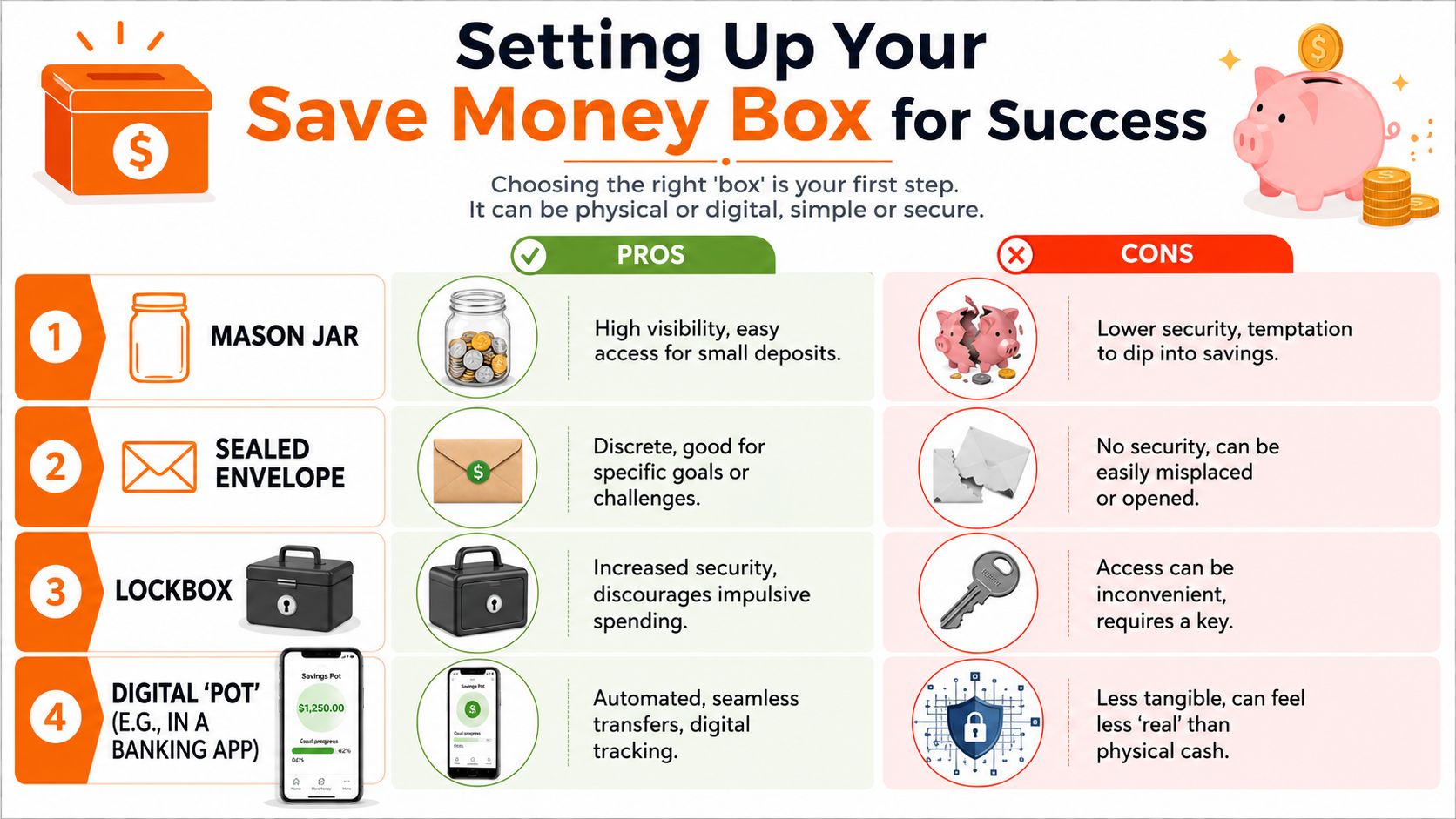
Your container should match the kind of saving you are trying to do.
| Box type | Good fit for | Watch out for |
|---|---|---|
| Mason jar | Daily change, visibility, easy habit building | Easy to open and dip into |
| Sealed envelope | One short-term goal, such as gifts or school fees | Easy to misplace |
| Lockbox | Bigger cash goal, more separation from spending | Less convenient access |
| Digital pot | People who prefer automation and app-based tracking | Can feel less tangible |
A jar works like a clear measuring cup in the kitchen. You can tell at a glance whether you are making progress. A lockbox works more like putting leftovers in the freezer. You can still get to it, but not casually. That extra friction helps if you tend to raid your savings for small wants.
For many adults, the strongest setup is a hybrid one. Use a physical box for the habit trigger, then log each deposit in your notes app, spreadsheet, or banking tracker. The box gives you the action. The digital record gives you accuracy.
Choose one goal that feels real
A label like “save money” is too foggy to guide behavior. A label like “weekend trip in October,” “new skill course,” or “car insurance excess” gives your brain a target it can picture.
That matters because short-term shocks are common. The Federal Reserve's survey on household finances has repeatedly found that many U.S. adults would struggle to cover a modest emergency expense with cash or its equivalent. A small, focused box helps you build that first layer of resilience before the money moves into a bank account or a broader savings plan.
Personal goals often work even better than generic ones. “Emergency fund” is sensible, but “passport renewal and train tickets for my sister's wedding” can be more motivating because you can see the outcome. If the goal is tied to a predictable bill or annual expense, a sinking fund for irregular expenses gives the box a clear job inside your wider budget.
A named box is easier to protect than a pile of spare cash.
Build a setup you can maintain
Keep the first version simple.
- Write the goal on the box. Make it specific enough that you would hesitate before taking money back out.
- Choose a home for it. Visible beats hidden for reminders, but private beats exposed for security.
- Decide how you will track it digitally. A phone note with dates and amounts is enough to start.
- Set a transfer point. Once the box reaches a certain amount, move the cash to a bank account.
- Add a visual cue. If reminders help you stay consistent, you can visualize goals on your devices so the digital side matches the physical habit.
One caution matters here. A money box is best for short-term saving and habit building, not for storing large amounts of cash for long periods. The box is the launch pad. Your account is the safer home once the balance grows.
Defining the Rules of Your Savings Game
A box without rules turns into clutter. A box with rules turns into a habit.
Individuals don't fail because they chose the wrong jar. They fail because they never decided what counts as a deposit. The easier the rule is to remember, the more likely you are to keep going.
Start with one automatic rule
Think of your save money box as a personal game. You're not trying to create pressure. You're creating a repeatable action.
Try one of these:
- Empty-pocket rule. Every evening, all coins from your pocket or bag go in the box.
- Specific-note rule. Save every note of one type that you receive.
- End-of-week sweep. Any cash left in your wallet at week's end goes into the box.
- Impulse-reset rule. If you skip a small non-essential purchase, move that amount into the box instead.
The best rule is the one that fits your real routine. If you rarely use cash, a “weekly transfer into an envelope” rule may suit you better than a coin jar.
Make the rule visible
A habit sticks faster when you can see both the action and the reason behind it. A sticky note on the box works. A line in your planner works. A note in your wallet works.
You can also visualize goals on your devices if you want a digital reminder that mirrors the physical box. That works well for people who need a prompt before the habit becomes automatic.
Save by rule, not by mood.
Keep the game fair
If the rule feels punishing, you'll quit. If it feels too loose, nothing happens.
Use this filter when choosing your rule:
- Can I do this without much thought?
- Can I keep doing it on a busy week?
- Will I resent it after a month?
If the answer is yes, no, and no, you probably have a workable system.
For readers who want to connect simple habits with a wider money plan, planning personal finance is a helpful next step.
Creative Methods to Accelerate Your Savings
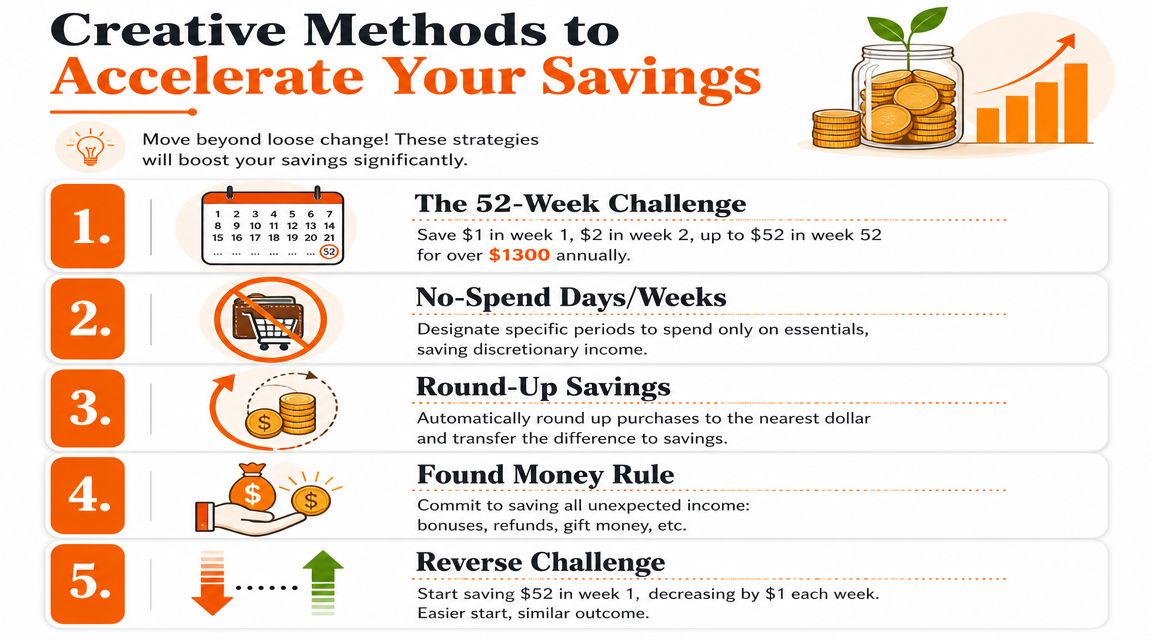
Once the base habit is working, you can make the save money box do more than collect spare change. It then becomes a planning tool.
Use the box for lumpy expenses
Many budgets look fine until an irregular bill shows up. Holiday shopping, annual fees, school costs, or car-related expenses can throw off a normal month because they don't happen on a neat schedule.
The Consumer Financial Protection Bureau notes that irregular, “lumpy” expenses are a common reason plans break down, and one practical method is to divide an annual cost by 52 and make small weekly deposits into a savings tool, as explained in this automatic savings and irregular bills guide.
That means your save money box can become a set of mini sinking funds:
- Car costs in one labelled envelope
- Holiday spending in another
- School or activity fees in a third
- Home extras in a fourth
When each category has its own label, you stop treating all savings as one pile of “extra money”.
Try a booster method
If you want faster momentum, add one challenge on top of your regular rule.
A few good options:
- No-spend leftovers. After a no-spend day, put the unspent discretionary cash into the box.
- Found money rule. Save gift cash, refunds, or money you didn't expect.
- Round-up habit. If you spend cash and get coins back, all the change goes in immediately.
These methods work because they turn irregular wins into planned savings instead of accidental spending.
Link everyday savings to a real category
Small spending changes become more motivating when they have a destination. If you cut back on takeaways or shop more carefully, move that difference into a labelled section of your box rather than leaving it floating in chequing.
For example, readers trying to lower food costs may find ideas in smart grocery shopping for Australians, then apply the same principle by moving those grocery savings into a holiday or car-cost envelope.
If your box is funding travel, budgeting for a trip helps you break that goal into smaller categories so your savings don't disappear into one vague pile.
Keeping Score and Staying Motivated
You drop a $10 note into the box on Monday, a few coins on Wednesday, and another $20 at the end of the week. By the end of the month, the box feels heavier, but your brain still asks the same question: “Is this adding up?”
That question matters more than many adults realise. A save money box works because it makes saving visible and physical. Tracking gives that habit a second layer. It turns a good intention into proof. In behavioural finance terms, you are reducing guesswork and giving yourself a small reward each time you record progress.
Keep a scorecard you will actually use
A notebook works well. A notes app works too. The best system is the one you can keep up with in under a minute.
Each time you add money, record three things:
- the date
- the amount
- the goal
That small record does more than count cash. It shows your pattern. If you miss two weeks, you will see it. If small amounts are building faster than you expected, you will see that too.
A simple entry might look like this:
- 3 May, $8, holiday fund
- 6 May, $3.50, holiday fund
- 9 May, $15, holiday fund
On their own, those deposits look tiny. Read a full month of entries in one sitting, and the story changes. What felt like “just spare change” becomes clear evidence that you are someone who saves regularly.
The physical habit gets stronger when the progress is digital too
Adults often do better with both forms of feedback. The box gives you the satisfying act of setting money aside by hand. A digital log gives you the running total, the trend, and the reminder of what the money is meant to do.
Fintrack can fit naturally into that job if you want more structure than a notebook. You can log each deposit against a named goal and watch the total grow without opening the box and recounting everything. That bridge between physical saving and digital tracking is what turns a simple household habit into a system you can use for serious targets.
If your next step is comparing where saved money should go after it leaves the box, a guide to a high-interest savings account for parked cash can help you think beyond the jar or tin on the shelf.
Motivation comes after evidence
Many savers wait to feel inspired first. In practice, motivation usually follows action.
A short review once a week is enough. Ask:
- What did I add this week?
- Did I follow my rule most of the time?
- How close am I getting to the target?
- Does this goal still matter to me?
Those questions keep the goal alive. They also stop the box from becoming background furniture.
If you reach a point where your goals are expanding beyond short-term spending and into bigger financial plans, you may start reading about options like investing in real estate with limited capital. Even then, the lesson from the money box still holds. Progress is easier to keep going when you can see it clearly.
When to Graduate from Your Money Box
You open the box one evening and realize the stack of bills now feels a little too important to leave on a shelf. That moment matters. It usually means the box has done its job, and your next task is to move the money somewhere safer and easier to track.
A good rule of thumb is simple. Once the box holds more cash than you would be comfortable losing, deposit it. For many adults, that point might be around $500, but your number can be lower or higher depending on your situation. The trigger is not a perfect amount. It is the moment the money starts feeling like part of a serious goal rather than spare change.
Another clear trigger is timing. If the money is meant for a bill due soon, an emergency fund, or a planned purchase within the next few months, move it before you need it so it is ready to use. If the goal is getting larger or stretching further into the future, a savings account gives you more protection and a cleaner record of progress. A high-interest savings account for parked cash is often a practical next step.
Signs you're ready to move on
You've outgrown the box when:
- You've reached your transfer limit and keeping the cash at home feels risky
- The goal date is getting close and you want the money ready to use
- You need a clearer record for a larger target like travel, a car repair, or a buffer fund
- You're saving for something longer term and want the money in an account built for that job
The box works like training wheels. The account is the bicycle you use once balance is no longer the main lesson.
Your next steps can be simple. Count the money, record the total, deposit it into a dedicated account, and label that account with the same goal name you used for the box. That keeps the behavioural win intact. You still get the habit cue from the physical box, but the money itself moves into a place that fits a bigger plan.
If your goals start expanding beyond cash savings, you may also begin looking at broader options such as investing in real estate with limited capital. The key is sequence. Build the habit first, then give the money a better home once the habit starts producing real results.
A money box should stay in your system even after you graduate from using it as storage. It can remain your capture tool for weekly cash deposits while your account becomes the place where those deposits accumulate and grow.