A paycheque arrives, the rent or mortgage payment leaves, groceries take another portion, and a few small purchases fill the gaps. By the third week, there's little left, even though the income looked sufficient at the start of the month.
So, what is a good monthly budget? It isn't a perfect percentage split or a list of restrictions. It's a practical plan that matches your after-tax income, household, location, fixed bills, savings needs, debt payments, and the costs you control.
A Good Monthly Budget Starts With the Right Definition
A good budget does four jobs at once:
- Covers essentials: Housing, utilities, food, transport, insurance, healthcare, and required debt payments are planned before optional spending.
- Moves money toward priorities: Savings and extra debt payments receive a defined amount instead of whatever happens to remain.
- Allows normal life: Dining out, entertainment, hobbies, gifts, and personal purchases have limits, but they don't disappear from the plan.
- Handles disruption: A repair, bill increase, or other surprise doesn't immediately force you to use credit.
That last point matters. A budget isn't successful because every category looks tidy on paper. It's successful when the plan still gives you a reasonable response to an unexpected cost.
Practical rule: A budget is a forecast and a boundary, not a punishment.
Start with plain language: income in, essentials out, savings set aside, life permitted. The amount available for flexible spending is the remainder after those first responsibilities are covered. If the result is negative, the problem isn't a lack of discipline. Your plan needs a change in spending, income, timing, or priorities.
A useful budget also gives you a way to judge the month. On the final day, you should be able to compare planned and actual spending and see where the difference came from. The Financial Consumer Agency of Canada recommends listing income, needs, and wants, then comparing the plan with actual spending and updating it when circumstances change. Its budgeting guidance supports a flexible process based on real statements and bills rather than assumptions.
For a broader explanation of how a budget supports everyday decisions, read why budgeting is important. The central idea is simple: a good monthly budget should help you make decisions before money leaves your account.
The Three Numbers Every Budget Needs First
Suppose your paycheck arrives on Friday, but rent, insurance, groceries, and debt payments are due before the next payday. A workable budget starts by measuring the money available after taxes, then separating required bills from spending you can adjust.
Every monthly plan needs three building blocks:
- After-tax income
- Fixed essential costs
- Variable controllable costs
Use the amount that reaches your account. Gross income helps with salary or tax discussions, but your spending plan runs on take-home pay. For a definition of what annual gross income means, compare the amount before deductions with the amount deposited. If your income changes, use a conservative average or build the plan around the lowest dependable amount.
Start with the money you can use
California's 2022–2023 Consumer Expenditure Survey provides a useful reality check. The average consumer unit spent $89,922.25 per year, or approximately $7,493 per month before taxes. The lowest reported income quintile averaged $41,965.09 annually, about $3,497 monthly, while the highest averaged $159,084.69, roughly $13,257 monthly. These figures come from the U.S. Bureau of Labor Statistics California income-quintile data.
These averages are reference points, not spending targets. Household size, income, debt, and location can change the amount available for every category.
Separate required commitments from steering choices
Fixed required costs usually include rent or mortgage payments, utilities, insurance, minimum debt payments, transportation, and a baseline grocery amount. Some may fluctuate slightly, but they belong near the front of your plan because skipping them can create immediate problems.
Variable controllable costs include dining out, delivery, entertainment, clothing, ride-sharing, hobbies, and nonessential shopping. These categories work like a steering wheel. You can adjust them first when housing or debt payments leave less room than expected.
| Fixed vs. Variable Costs by Region | City or region | Median after-tax monthly | Housing share | Utilities and insurance | Variable discretionary |
|---|---|---|---|---|
| California statewide | Use your actual take-home pay | Housing and utilities average about 38% of expenditure | Add actual bills | Set from transaction history |
| California lower-income households | Use your actual take-home pay | Housing and utilities reach about 44% of expenditure | Add actual bills | Keep flexible spending tightly defined |
| Los Angeles metropolitan area | Local spending averages about $7,173 monthly | Housing represents 36.6% of spending | Add actual bills | Dining and delivery are material levers |
| San Francisco–Oakland–Hayward | Local spending averages approximately $9,798 monthly | Housing represents 36.2% of spending | Add actual bills | Review food, transport, and other controllable costs |
The California housing figures come from the Berkeley Economic Studies Initiative analysis. The metropolitan figures come from the BLS Los Angeles consumer expenditure release. For gross-income housing burden, HUD uses a threshold of at least 30% of gross income, and 42.4% of California households exceeded it in 2024, according to USAFacts' California housing data.
The key calculation is personal: income in, required costs out, and controllable spending assigned only after those commitments are covered.
Popular Budgeting Frameworks Compared
A framework gives your budget a shape. It doesn't decide whether the shape fits your life.
Four common approaches
| Budgeting framework | Core rule | Best for | Where it breaks down |
|---|---|---|---|
| 50/30/20 | Divide take-home pay between needs, wants, and savings or debt | People who want a quick starting structure | Housing and essential costs can leave too little for the other categories |
| Zero-based | Assign every dollar of income to a job | Freelancers, variable earners, and households with several goals | Requires regular updates when income or bills change |
| Envelope method | Give spending categories defined limits, often with separate cash or digital balances | Anyone targeting a problem category such as delivery or impulse shopping | Can feel restrictive when many categories need frequent adjustments |
| Pay-yourself-first | Move savings or debt payments out before flexible spending | People with dependable income and a clear priority | Essential costs may be underestimated if the transfer is too aggressive |
The 50/30/20 rule is easy to understand, which makes it useful as a first sketch. It becomes less practical when housing absorbs a large share of income, as it does for many California households. Use the 50/30/20 budget rule as a comparison point, not as a verdict on whether your finances are healthy.
Zero-based budgeting is more detailed. After-tax income minus every planned category equals zero, but zero doesn't mean you spend everything. Savings, annual bills, and debt reduction are categories too. This approach works well when income arrives unevenly or when two people need to coordinate many commitments.
Envelope budgeting creates a visible spending wall. You might separate money for groceries, restaurants, entertainment, and personal spending, then stop or adjust when an envelope is empty. It's particularly useful when emotional spending happens quickly and a simple warning in an app isn't enough.
Pay-yourself-first protects a priority before optional spending begins. It can support emergency savings or high-interest debt repayment, but only after you've confirmed that housing, food, transport, insurance, healthcare, and minimum payments remain covered.
No framework beats a budget you won't open. Choose based on your income pattern, housing pressure, debt, household structure, and tolerance for detail. The method isn't a moral ranking. It's a tool.
How to Calculate Your Own Budget Step by Step
Start with your actual after-tax income and local costs, then choose a budgeting method. A percentage rule can provide a useful outline, but it cannot show whether your rent, debt, or childcare costs leave enough cash for the rest of your life.
- Write down after-tax income. Use dependable income only in the first version. If pay varies, start with the lower amount you can reasonably expect.
- List fixed essentials. Record housing, utilities, insurance, transport, groceries, healthcare, and minimum debt payments.
- Add irregular costs. Turn annual or occasional bills into monthly sinking-fund contributions.
- Choose a framework. If fixed essentials, especially housing, use more than 40% of take-home pay, start with zero-based budgeting so every remaining dollar has a job. If required costs leave enough room for percentage allocations without cutting necessities, 50/30/20 can provide a simpler structure. Use envelopes when flexible spending is the main problem.
- Assign savings, debt reduction, and flexible spending.
- Compare the plan with actual transactions. Adjust categories when real spending repeatedly differs from the estimate.
See the housing-share examples in section 2 for context. The point is to measure how much cash remains after required costs, rather than copy a California dollar example into a different household.
Build the line items before choosing percentages
For a single professional, enter actual rent or mortgage, utilities, transit, insurance, groceries, minimum debt payments, and healthcare. Then divide the amount left among retirement, emergency savings, extra debt payments, and discretionary categories. If housing takes most of the income, a zero-based plan makes the trade-offs visible. It may show that flexible spending or an optional goal must change.
For a family, add childcare, school costs, family healthcare, larger grocery needs, and transport for dependants before setting savings targets. The test is whether required costs fit within income and whether the budget names the category to reduce when they do not.
For a dual-income couple, list each person's income and decide whether money is fully shared, partly shared, or separated by responsibility. Fund joint housing and household costs first. Then agree on personal spending, shared goals, and the treatment of irregular bills.
| Sample monthly budgets for three households | Single professional | Family household | Dual-income couple |
|---|---|---|---|
| Income | Enter combined after-tax pay | Enter combined after-tax pay | Enter combined after-tax pay |
| Housing and utilities | Record actual bills | Record actual bills | Record actual bills |
| Groceries | Use recent statements | Use recent statements | Use recent statements |
| Transit or vehicle costs | Add required costs | Add required costs | Add required costs |
| Insurance and healthcare | Add premiums and regular costs | Include family needs | Include each person's costs |
| Minimum debt payments | Add every required payment | Add every required payment | Add every required payment |
| Savings and emergency fund | Assign the remaining priority amount | Protect a realistic recurring amount | Coordinate shared and personal goals |
| Flexible spending | Set category limits | Set household and personal limits | Set shared and individual limits |
Two factors change nearly every result: dependants and debt load. A smaller household can still have little flexibility when housing or debt is high. A larger household may have more room when its fixed commitments are lower.
Use a monthly budget calculator to organise these figures. Treat the result as a working plan, then revise it when actual transactions reveal a better estimate.
Handling Irregular Expenses and Quiet Inflation
Monthly bills are only part of the cost of living. Annual insurance, vehicle repairs, gifts, subscriptions, school costs, medical expenses, and property-related bills can destabilise a budget when they arrive as surprises.
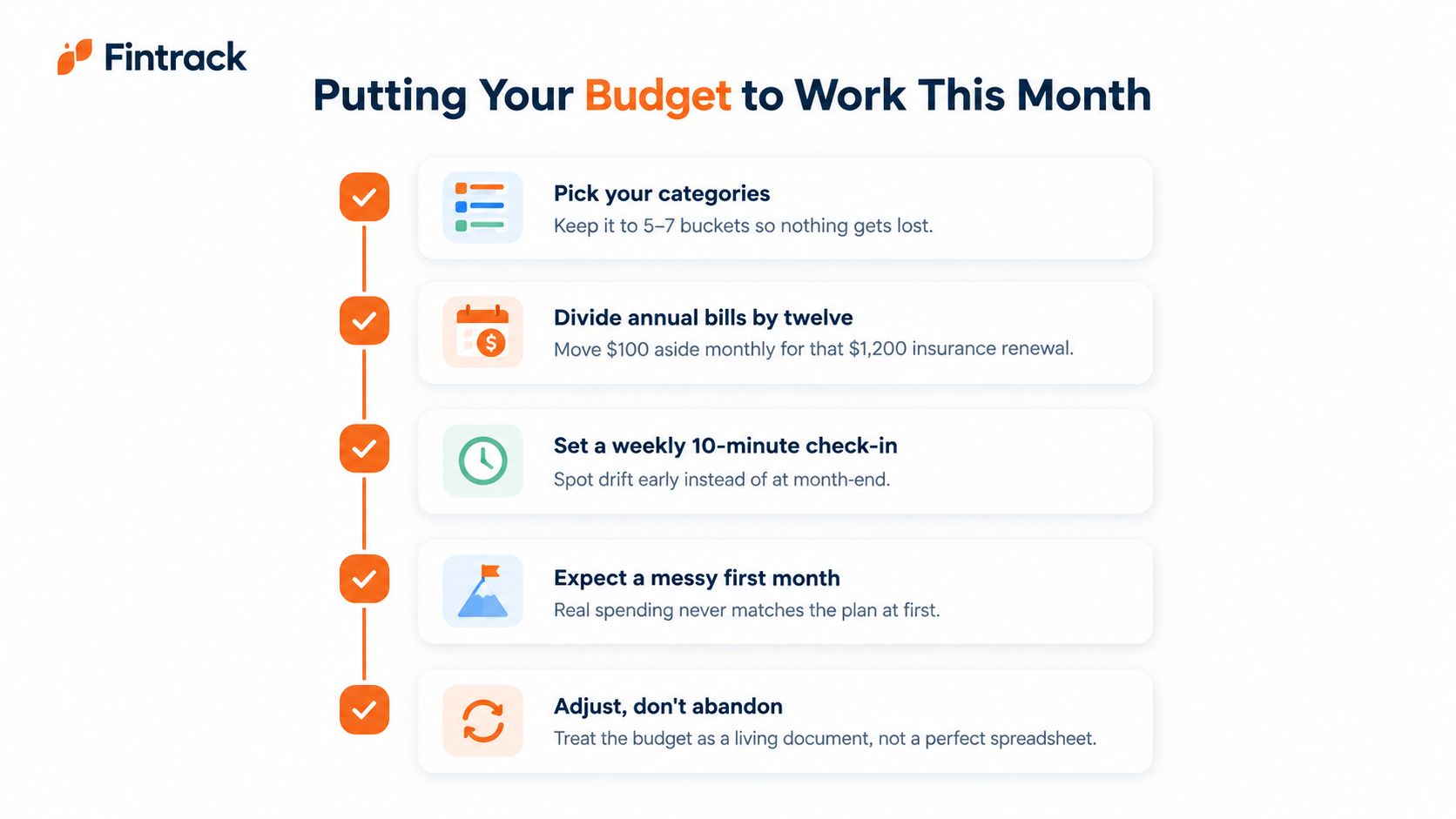
A sinking fund changes the timing. Take the expected annual cost, divide it by the number of months before it is due, and move that amount aside regularly. A $1,200 annual bill becomes $100 per month, an example also shown in the required visual below. The money isn't extra spending. It's a monthly reservation for a known future obligation.
Planning habit: Ask which monthly amount prevents a predictable future bill from becoming new debt.
Use last year's real spending as your starting point for categories such as groceries, fuel, utilities, and maintenance. Add a modest buffer when a category is volatile, then review it quarterly instead of waiting for the annual bill to expose the gap.
For a category-by-category reference when planning household bills, review this guide to average utilities cost per month. The value is not a universal target. It's a prompt to compare your own statements with what you've been paying.
Three small routines catch quiet drift:
- Audit subscriptions quarterly: Check recurring charges and cancel services you no longer use.
- Put due dates on a calendar: Add insurance, property tax, renewals, and school-related payments before they become urgent.
- Check balances weekly: A short review helps you spot rising prices, duplicate charges, or a category that is running ahead of plan.
California's revised economic outlook projected 3.8% inflation for 2025 and 3.7% shelter inflation, so a budget should allow for costs that rise at different rates. The state economic outlook supports reviewing category assumptions rather than treating last year's amount as permanent.
A sinking-fund method can make those adjustments easier to manage. Learn more about what a sinking fund is before building your annual-cost categories.
Choosing the Right Way to Track and Adjust
A budget only works if you can keep it current. The best tracking method is the one that captures purchases accurately enough for you to make decisions before the money is gone.
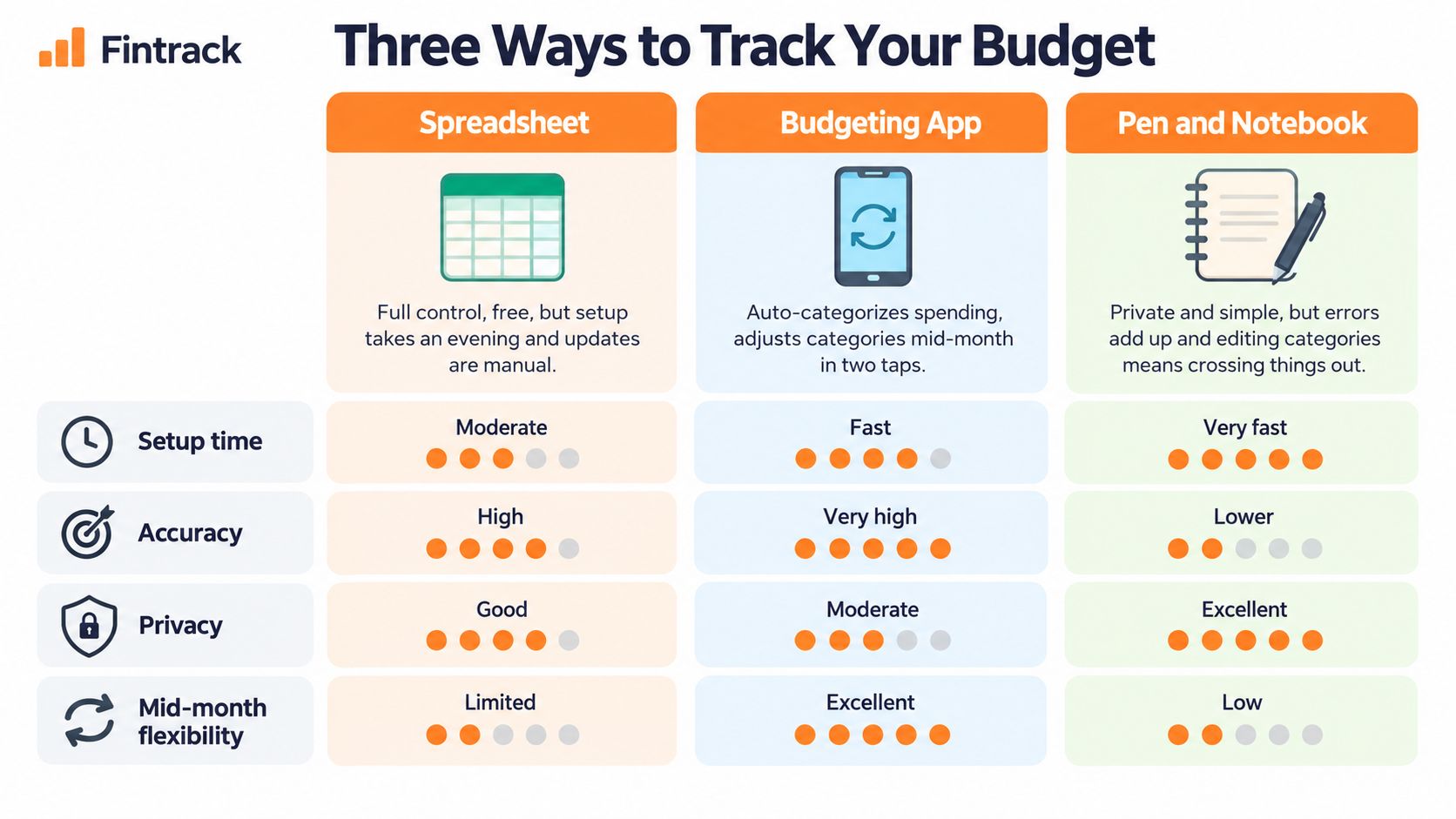
A spreadsheet gives you control over categories, formulas, and historical comparisons. It suits someone who's comfortable entering transactions manually and wants to change the structure without depending on a bank connection. The trade-off is consistency. If you skip entries, the sheet stops reflecting reality.
A bank-linked app reduces manual work and can help people who regularly forget transactions. It may still need corrections when a merchant is categorised incorrectly, a connection drops, or a purchase belongs partly to another category. Privacy preferences also matter, so choose a method that matches your comfort level.
A pencil-and-envelope approach, including prepaid cards for selected categories, creates a firm limit. It can help when overspending is emotional or immediate, although it becomes less convenient for online purchases and changing priorities.
Look for four practical capabilities when choosing a tool:
- Manual entry: You should be able to record cash, transfers, and purchases that never reach a connected account.
- CSV import: A file import gives you a fallback when a connection fails.
- Category overrides: You should be able to correct every category without fighting the system.
- Rollover options: Unallocated cash should be allowed to continue into the next month when that matches your plan.
Fintrack offers manual entry, budget planning, category-level limits, and an AI assistant that can answer questions about spending using the information you provide. For practical advice on capturing purchases and receipts, these Snyp receipt tracking tips can help you improve the accuracy of your records.
Putting Your Budget to Work This Month
The first month won't be clean. Real spending rarely follows the plan exactly, and that's useful information rather than proof that budgeting failed.
Review the budget every Friday for a short, focused check-in. Compare planned and actual spending, look at upcoming bills, and move money between categories when the change reflects a real priority. Don't overspend and hope the next month repairs the damage.
Use this month as a test:
- Choose the framework that matches your household. Use 50/30/20 for a simple sketch, zero-based planning for detailed control, envelopes for problem categories, or pay-yourself-first when a defined savings or debt priority comes first.
- Copy the line-item method. Start with actual income, fixed essentials, irregular costs, savings, debt payments, and flexible spending.
- Run the plan for one month. Record what happens before changing every category.
- Review the evidence. Identify which costs were underestimated, which categories were too tight, and which subscriptions or habits were easy to miss.
- Revise without abandoning the plan. A useful budget becomes more accurate as it learns from your transactions.
The second month often becomes more useful because your categories begin to show honest averages. Progress doesn't require perfection. Following the plan most of the time, then making a calm correction when life changes, is more valuable than creating a detailed budget you never check.
Revisit your plan when your income, housing cost, debt, or family size changes. Those events alter the numbers, so they should alter the budget too.
Fintrack brings income, expenses, budgets, and goals into one dashboard, with manual entry and personalised spending insights for people who don't want to rely entirely on spreadsheets or bank connections. Visit Fintrack to set up a budget based on your actual categories, review spending during the month, and adjust the plan as your circumstances change.