Maya gets paid twice a month and the money lands on time, yet by the last week she's checking her balance before buying groceries. Nothing dramatic went wrong. The money just left in small, unplanned pieces, and savings never got a turn.
Why a Monthly Budget Starts With Your Real Numbers
Maya takes home $4,200 a month, but she's never written her money down, so every bill feels like a surprise. She isn't unusual. In 2025, 42% of Canadians identified money as their leading source of stress, according to FP Canada's national Financial Stress Index survey.
A personal budget monthly is a plan that assigns every dollar of take-home pay to a job for one calendar month. It covers bills, spending, savings, and a small buffer. That's different from a spending limit, which only caps one category. A budget decides where money goes before it leaves the account.
You don't need a spreadsheet or a bank connection to do this. Manual entry works, especially if you're building the habit and want to see each transaction. A simple income and expense tracking routine is enough to start.
By the end, you'll have:
- A finished monthly budget: built on your actual take-home pay
- A savings line: paid on payday, not from leftovers
- A weekly check-in habit: short enough to keep
- A month-end routine: so next month starts from real numbers
Sort Your Expenses Into Categories That Fit Real Life
Categories should reflect when and why money moves. Start with four types, then divide them into practical budget lines.
Four types to sort first
- Fixed: rent, insurance, and loan payments that usually stay the same each month
- Flexible: groceries, dining out, and fuel, where the amount changes with your choices
- Savings: money you set aside on purpose, including an emergency fund
- Irregular: annual bills, gifts, and car repairs that do not arrive monthly but still need funding
The largest spending areas are easier to manage when they have separate lines. Canadian households spent an average of $76,750 on goods and services in 2023, including $24,671 on shelter, $12,090 on transportation, and $12,046 on food, according to Statistics Canada's household spending release.
Canadian average household spending by category
| Category | Annual average | Monthly average | Share of spending |
|---|---|---|---|
| Shelter | $24,671 | $2,056 | 32.1% |
| Transportation | $12,090 | $1,008 | 15.8% |
| Food | $12,046 | $1,004 | 15.7% |
| All goods and services | $76,750 | $6,396 | 100% |
These figures are national averages, not targets. Your income, city, household size, and housing situation all affect what is workable. A renter in Toronto and a homeowner in a smaller city should not expect the same shelter costs.
Keep shelter, food, and transportation on separate lines because each changes for different reasons. If they share one general category, you cannot tell whether groceries or fuel pushed spending up. Keep roughly ten to twelve categories total, and name them to match your actual habits. If the miscellaneous line keeps growing, split out the spending that is hiding there. For ideas, browse these common categories of expense and remove any that do not fit your life.
Quick exercise: Take your last 20 transactions above $50 and assign each to one category. If you cannot place a transaction within ten seconds, make the category name more specific. A clear label makes it easier to spot where the money went and adjust the right budget line.
Build Your Personal Budget Monthly in Five Steps
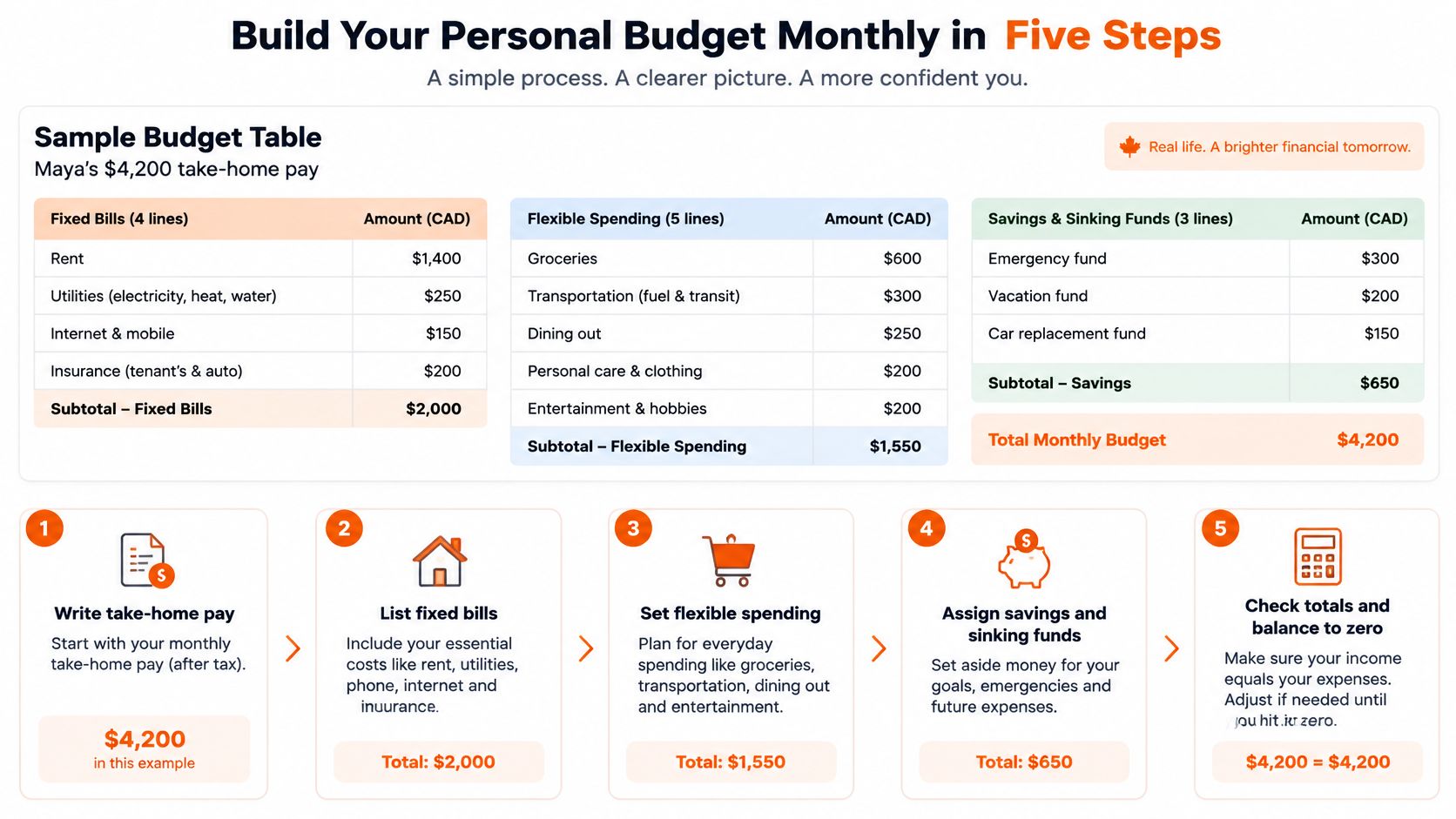
Start with what a finished version looks like. Here's Maya's budget on $4,200 take-home pay, split into twelve lines.
Sample monthly budget on $4,200 take-home pay
| Category | Type | Monthly amount |
|---|---|---|
| Rent | Fixed | $1,650 |
| Utilities and phone | Fixed | $200 |
| Groceries | Flexible | $550 |
| Transportation (transit and fuel) | Flexible | $250 |
| Insurance (car and renters) | Fixed | $200 |
| Minimum debt payments | Fixed | $150 |
| Dining out and entertainment | Flexible | $250 |
| Subscriptions | Fixed | $60 |
| Emergency fund transfer | Savings | $200 |
| TFSA contribution | Savings | $300 |
| Sinking fund for annual bills | Savings | $150 |
| Personal and miscellaneous | Flexible | $150 |
The lines total $4,110, leaving $90 unassigned as a buffer. Her core costs, rent, utilities, groceries, transportation, insurance, and minimum debt payments, come to $3,000.
The five steps
- Write take-home pay, not gross pay. Use the amount after tax and payroll deductions, because that's what you can assign. If your pay varies, use your lowest typical month. The common slip is budgeting from salary and wondering why you're short every time.
- List fixed bills with due dates. Rent, insurance, loan payments, phone, and subscriptions go in with the day they're due, not just the amount. People forget annual premiums here, so check a full year of statements, not one month.
- Estimate flexible spending from three months of statements. Average your groceries, dining out, fuel, and transit instead of guessing. One month can be unusually cheap or expensive. Guessing low feels disciplined and then fails by week three.
- Assign savings first. Emergency fund, TFSA contributions, and sinking funds for annual bills get lines before flexible spending expands to fill the space. Leaving savings for last means it gets whatever survives, which is usually nothing.
- Compare the total with your income. If you're short, trim flexible lines first. If there's a surplus, assign it to a goal on purpose rather than letting it drift.
I'd enter these numbers in Fintrack's budget setup so each line has a limit you can check during the month. When you're testing step 3, Finny can answer a question like "How much did I spend eating out this month?" so you're working from actual spending, not memory.
A healthy budget is simple to recognise. Every line adds up to take-home pay, savings has its own lines, and a small unassigned buffer absorbs the purchases you didn't predict. If the total only works with no buffer at all, the plan is too tight to hold.
Allocate Savings, Sinking Funds and Debt Payments
Savings works when it's a bill you pay yourself, with an amount and a payday transfer date. It fails when it's a vague intention to move what's left.
Size the emergency fund from your core costs
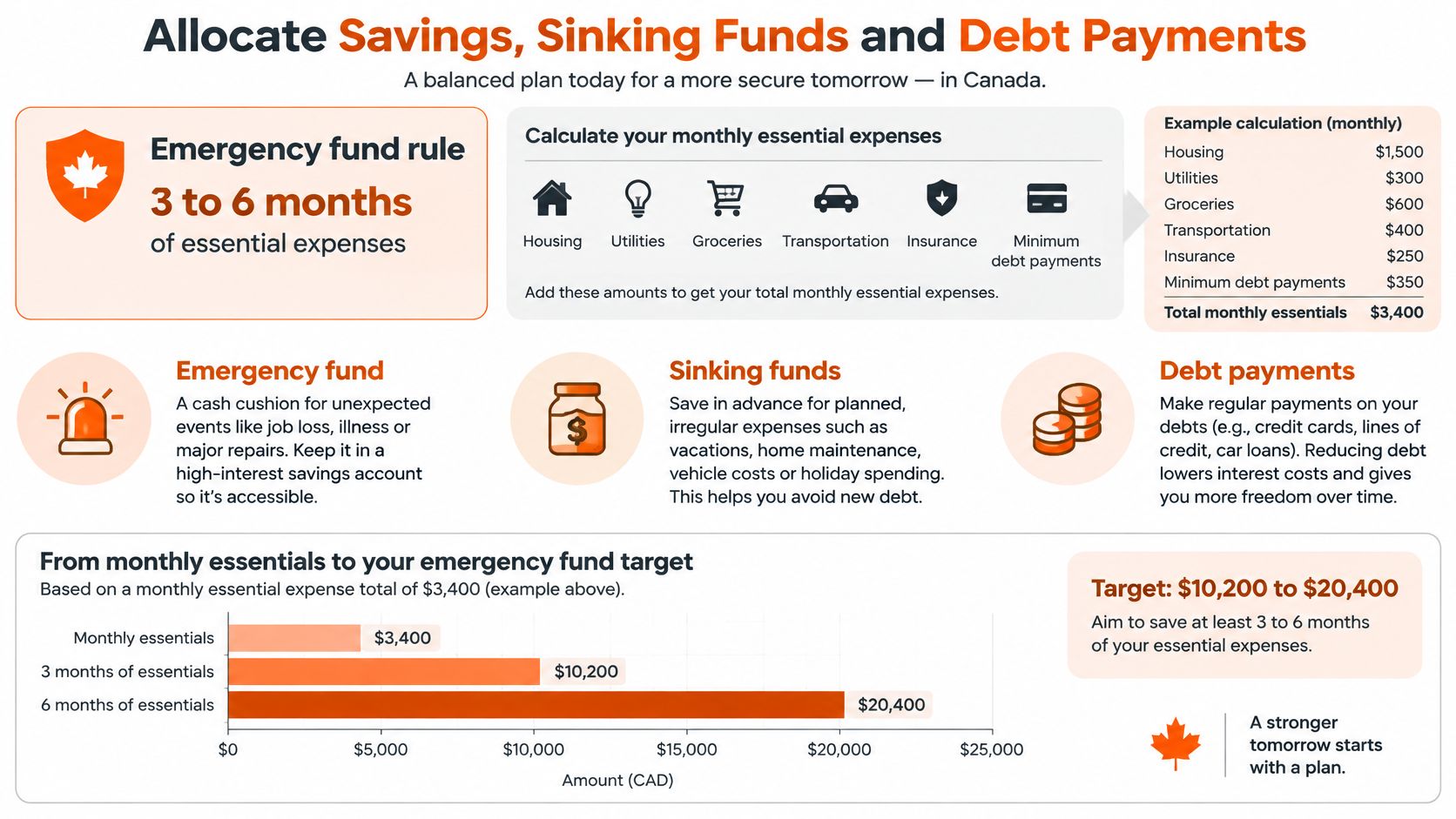
The Financial Consumer Agency of Canada's emergency fund guidance recommends 3 to 6 months of regular expenses, or alternatively 3 to 6 months of income. Add your essential monthly costs, housing, utilities, groceries, transportation, insurance, and minimum debt payments, then multiply by three and six. At $3,000 in core costs, the range is $9,000 to $18,000.
Emergency fund targets by core monthly expenses
| Core monthly expenses | 3-month target | 6-month target |
|---|---|---|
| $2,000 | $6,000 | $12,000 |
| $2,500 | $7,500 | $15,000 |
| $3,000 | $9,000 | $18,000 |
| $3,500 | $10,500 | $21,000 |
To turn a target into a monthly transfer, divide the remaining gap by the number of months you want to take. Start smaller if you need to, then raise the transfer when income rises or a recurring cost falls.
Sinking funds, TFSA room, and card minimums
Sinking funds handle the bills you can predict. Divide the yearly cost by 12, so a $1,200 annual insurance premium becomes $100 per month. If you're unsure which bills qualify, a sinking fund explained with examples will help you list them. The trade-off is real, since each sinking fund reduces money available now, but it stops an annual bill from wiping out a month.
For longer-term saving, the TFSA annual contribution limit is $7,000 for each year from 2024 through 2026, which works out to about $583.33 per month, based on the Canada Revenue Agency's TFSA contribution rules. Adjust that amount for your available contribution room, debt costs, and emergency savings. The limit is a ceiling for new room, not a monthly obligation.
Record the actual minimum on each card statement as a required debt payment, then assign extra toward repayment whenever you can. Don't count an unused credit limit as savings, and don't build any of these targets from gross income. Credit is borrowed room, not cash you own.
Treat each savings transfer as a bill paid first on payday. If it waits until month end, flexible spending will usually get there first.
Track Progress Each Week Without Logging Every Coffee
The budget is most useful when it shows whether your balance can carry you through to payday. A 15-minute weekly review, done on the same day each week, helps catch a shortfall while there is still time to adjust.
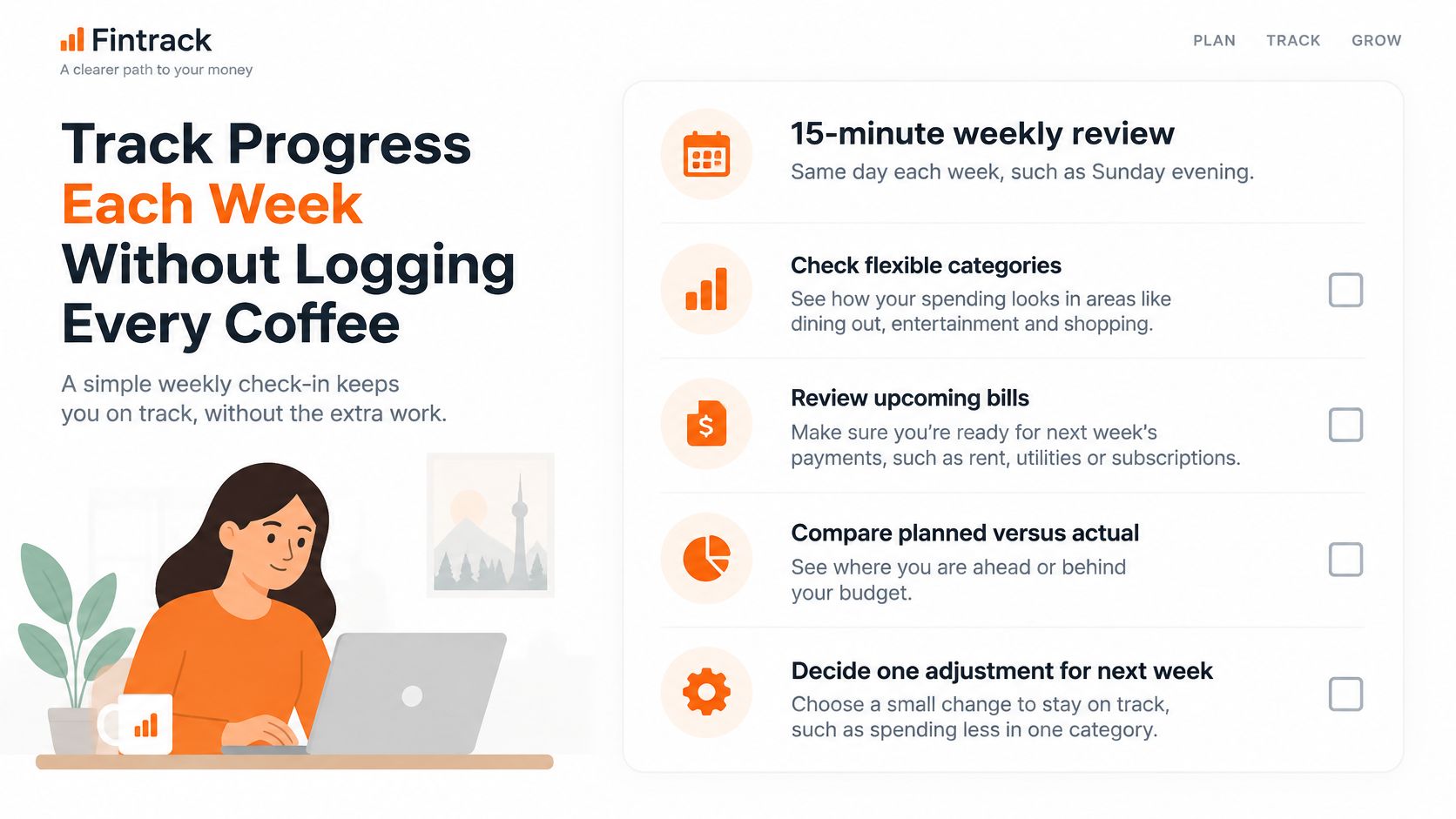
Check what remains in flexible categories, confirm upcoming bills fit your current balance, scan for unusual or duplicate charges, and make sure planned savings transfers cleared. Fintrack's real-time alerts flag likely duplicate charges, and its subscription detection can help identify recurring costs to review.
The weekly checklist
- Open the budget: note what remains in each flexible category.
- Look 14 days ahead: compare your current balance with bills due before your next payday.
- Clear odd charges: check duplicates, unfamiliar merchants, and renewals you forgot.
- Confirm savings posted: address a failed transfer now rather than at month end.
- Pick one change: choose a single adjustment for next week, not a full overhaul.
A category limit alone cannot show whether a purchase leaves enough for bills due before payday. Ask Finny a specific question, such as whether dining out still fits after rent and the phone bill are covered. Building a monthly spending tracking habit around upcoming bills and your lowest-balance date gives you a clearer view than a category total alone.
Cards need a weekly glance too. The Financial Consumer Agency of Canada's guide to paying off credit cards explains that minimums are commonly a flat amount, usually $10, plus interest and fees, or a percentage of the balance, typically 3%. Budget the statement minimum as required, then add extra when you can. Paying only the minimum takes longer and costs more interest. If card balances are your main concern, compare budgeting apps for credit-card debt before choosing a tool.
Watch for the date your balance is likely to run lowest, often just before payday. Category totals can look fine while the cash available that day falls short.
Review Your Budget at Month End and Adjust It
Setup gets the attention, but the month-end review is where a budget either becomes accurate or turns into fiction. Give it twenty minutes before the new month starts.
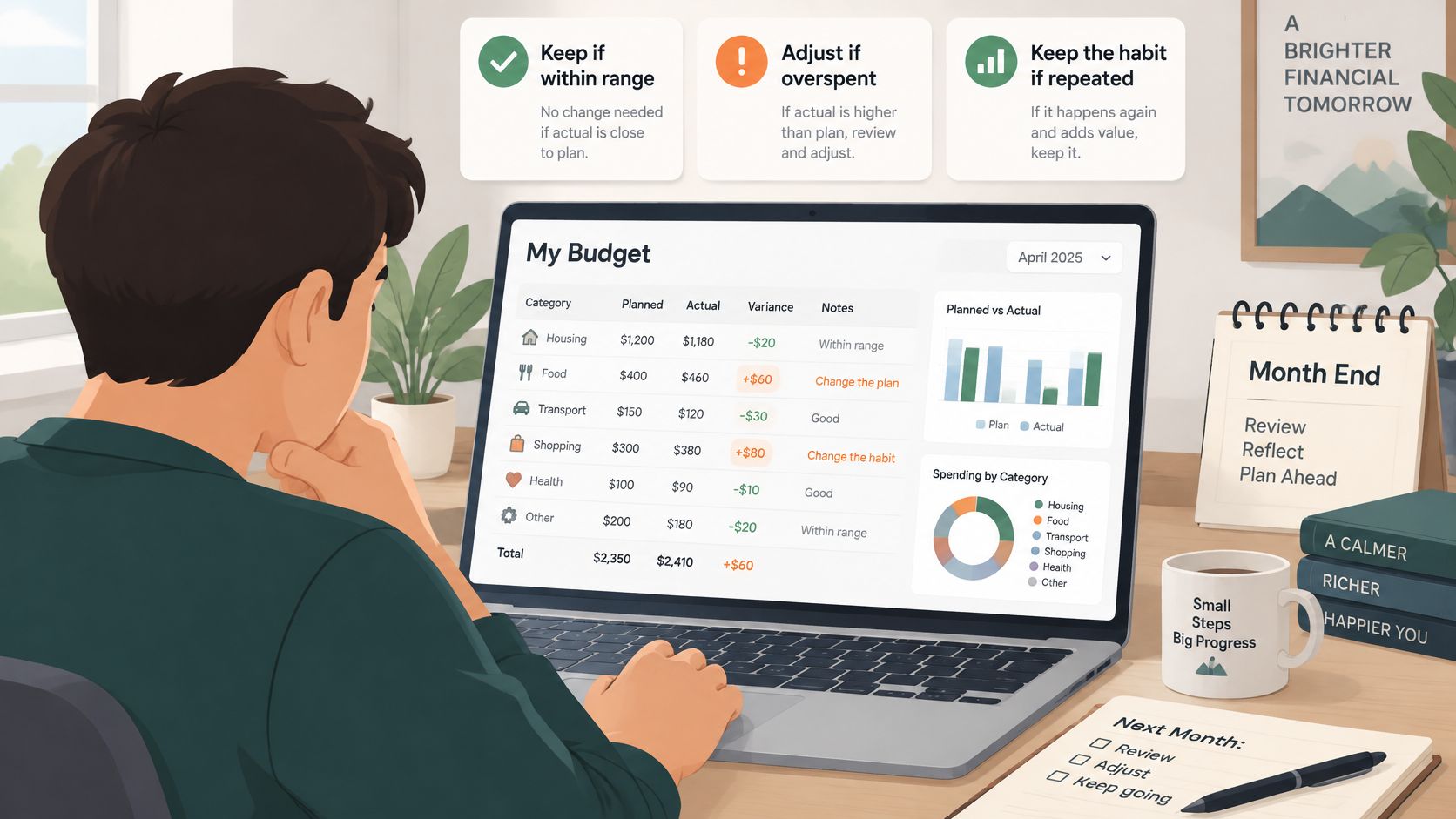
Compare planned and actual amounts for every line, then note the two largest variances. For each one, decide whether the plan was wrong or the habit needs to change. A grocery line that has run over for three straight months is probably a bad estimate, not a discipline problem. A budget variance analysis approach keeps that judgement consistent instead of emotional.
Decision rules for common variances
- A flexible category ran over: move money from another flexible line or accept the trade-off on purpose, but don't let it eat next month's buffer
- A savings transfer was missed: lower the target for one month rather than dropping it, because a smaller transfer keeps the habit alive
- Income changed: rebuild the budget from step 1 with the new take-home pay instead of patching individual lines
If you're short every month, the usual suspects are subscriptions you no longer use, bills you haven't renegotiated, and housing costs that leave too little for everything else. Work through them in that order, because cancelling a subscription takes five minutes and moving doesn't. If the budget never leaves any surplus at all, it's too tight to hold and you'll abandon it, so loosen one flexible line rather than pretending.
If you're considering a different tool, compare budgeting apps on whether they show upcoming bills against your balance and handle manual entry well, not on how many charts they offer. Those two features decide whether the weekly review stays quick.
For your next step, open Fintrack's budget planning setup, enter this month's take-home pay and fixed bills, and put your first month-end review on the calendar. The calendar entry matters as much as the numbers, because an unreviewed budget drifts within two months.
Set up your take-home pay, categories, and savings lines in Fintrack, then use its weekly alerts and month-end totals to run the exact review routine described here. You'll see your lowest-balance date coming, spot duplicate charges early, and start next month from numbers you trust.