A Winnipeg family checks the account after the hydro bill and finds it thinner than payday suggested. Rent left on time. Groceries ran high. Three takeout orders slipped in. Nobody can name which one opened the gap.
Household spending on goods and services has climbed in recent years, so a thin month is common. Income comes back as a clear number. Last month's spending comes back as "around the usual."
Expense management is the running record that shows whether a budget is working. It protects cash flow by separating a shortfall caused by spending behaviour, such as the extra takeout, from one caused by essential costs, such as heat or rent.
Recording each payment is only the first step. The review turns that list into a decision you can still make this month. The same record works in Hamilton or Halifax.
What Expense Management Means for Your Money
A Calgary renter opens her banking app on the 20th of the month and sees a balance lower than she expected. About $900 has left the account since payday. She can name the rent and the phone bill without looking. Everything else is a blur of groceries, a birthday gift, two coffee runs and something on the 14th she can't place.
That feeling, of money leaving without a story attached to it, is the problem expense management solves.
Expense management is the process of recording, categorizing, reviewing and controlling spending so you understand where money goes and can make informed budget decisions.
Think of it as the difference between a game plan and a scoreboard. A budget is the plan you write before the month starts: this much for rent, this much for groceries, this much into savings. Expense management is the scoreboard that runs during play, showing you the actual score while there's still time to change the outcome.

The process applies at every size. A $6 coffee and a $1,500 rent payment both belong in the record, because both move the balance and both have patterns worth seeing.
What Expense Management Is Not
It isn't tax filing, and it isn't your credit score. Those are separate systems with their own rules. Expense management is narrower and more useful: it's the running account of what your household earned and spent, kept current enough to act on.
Households in Canada and the United States run the same cycle. The container changes (an app, a spreadsheet, a notebook and a pen), but the steps don't.
Start with one small action this week: pull last month's bank statement and count how many lines you can't name without thinking. That number is your starting point, not a verdict.
Expense Tracking Versus Expense Management Compared
People use these two terms as if they were interchangeable. They aren't, and the difference decides what you do next.
Expense tracking is the recording step only. You log each purchase, bill and refund in an app, a spreadsheet or a notebook.
Expense management is the full cycle, which adds categorizing, reviewing and deciding what to change.
Budgeting sits beside both. It's the forward plan, with a limit for each category, written before the month begins.
One shared example makes the split obvious. Say your March records show $412 went to dining out.
- The tracker tells you the total: $412.
- Expense management tells you $412 hit a $300 limit by the 15th, and that cancelling one unused subscription covers most of the overrun.
- The budget is what set the $300 in the first place.
If you only need a record, tracking is enough. If you need to act on the numbers, you're managing. If you need a plan before the month starts, you're budgeting, and the plan will be guesswork until the record exists.
Business expense management (employee reimbursements, corporate cards, approval chains) follows the same logic with its own rules and audit requirements. This guide stays with household and personal money, where you're both the spender and the approver.
If the recording step is where you get stuck, how expense tracking works walks through the mechanics of logging purchases and receipts in detail.
How Expense Management Works in Four Stages
Expense management isn't a January cleanup you finish once. It runs as a repeating monthly cycle, and each pass gets faster as your categories settle.
That loop has four stages, and they only work as a loop.
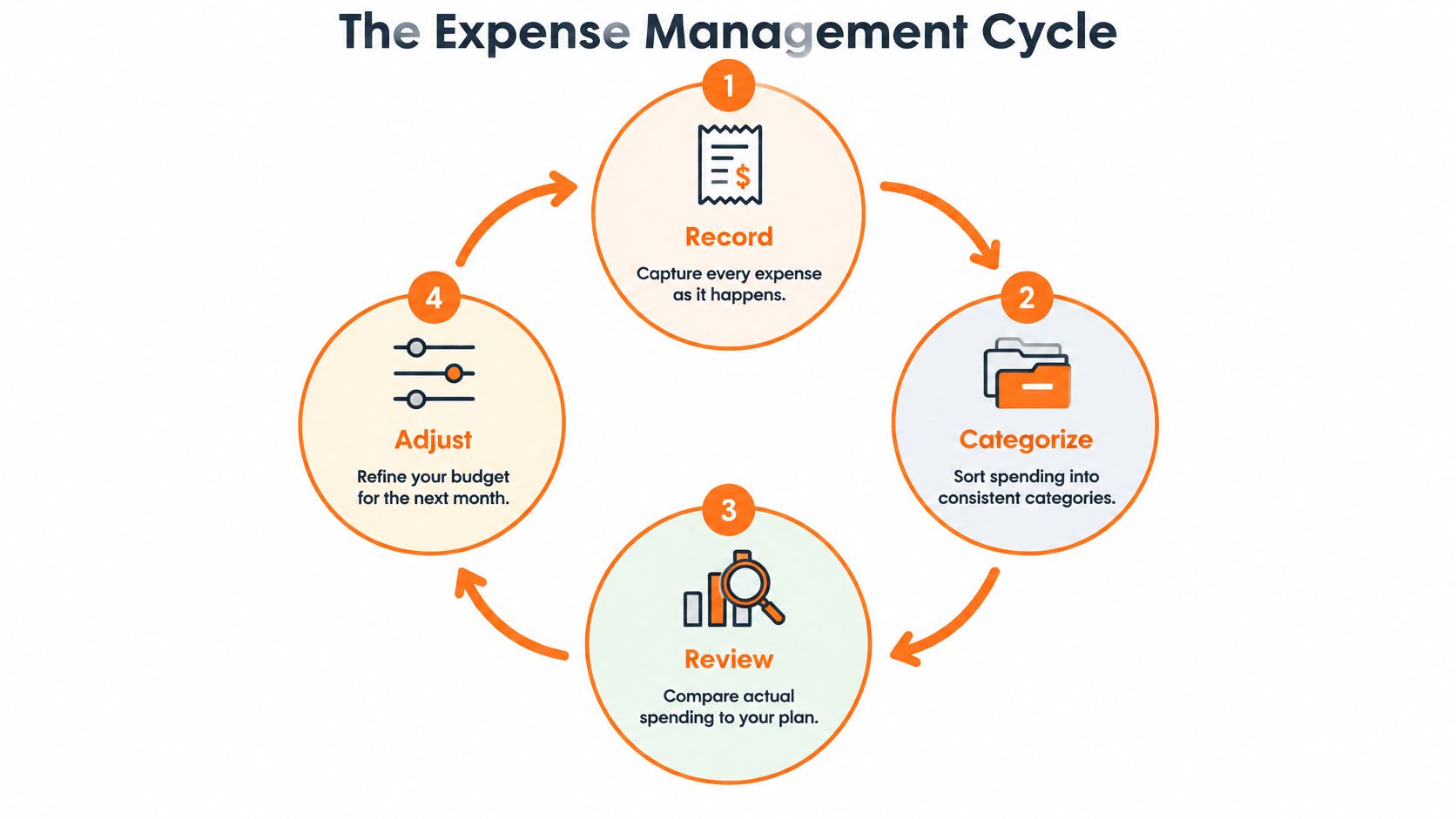
| Stage | What You Do | Example |
|---|---|---|
| Record | Capture every purchase, bill, transfer and refund | A $6 coffee and a $1,500 rent payment both land in the same list |
| Categorize | Assign each entry a broad category and a subcategory | Groceries under Food, phone bill under Utilities |
| Review | Compare category totals with your budget each week | Groceries reach $520 against a $480 limit on the 12th |
| Control | Make one change based on what the review showed | Cancel an unused subscription and lower the dining limit |
Why Weekly Beats Monthly
A $120 overspend found on the 15th still leaves two weeks to correct it. The same $120 found on the 30th is history. The review stage is where the timing matters most, and a short check every week beats one long audit at month end.
The first cycle takes the longest, because you're building categories and setting limits from scratch. Later cycles usually take a few minutes. After two months of steady practice, you can name your top three spending categories without opening a report, and can point to at least one change you made because a review surfaced it.
Control is the stage people skip. They record diligently, categorize carefully, review thoroughly, then change nothing. Control is what makes the other three worth the effort, and it only requires one adjustment per cycle.
The same matching discipline shows up in bookkeeping, where account reconciliation keeps your own records aligned with what the bank says happened.
Why Expense Management Matters for Household Budgets
The case for keeping a record is easiest to see in the national numbers. Statistics Canada's 2023 Survey of Household Spending puts average household spending on goods and services at $76,750, a 14.3% increase from 2021 and 11.3% above 2019.
Three categories account for most of that money: shelter at 32.1% of spending, transportation at 15.8% and food at 15.7%.
Notice what those categories have in common. None are impulse buys. Rent, mortgage payments, car costs and groceries arrive on a schedule, which is exactly why they stop being noticed. You don't decide to spend on them each month. They recur, and a recurring cost that nobody reviews tends to grow.
Transportation shows the pattern clearly. Average household spending there reached $12,090 in 2023, up 19.7% from 2021, according to the same survey.
Each of those totals mixes fixed commitments, variable necessities and discretionary purchases, and separating them is what turns a number into a decision. A clear record makes three things possible:
- Spot the category rising faster than income. A 19.7% climb in transportation only matters if your earnings didn't keep pace, and you can't compare what you haven't tracked.
- Judge whether a big commitment is crowding out savings. If car payments and rent consume most of the month, the savings shortfall is structural, not a willpower problem.
- See what's left for debt. The remainder after essentials is the number that determines how fast a balance falls.
A household tracking these categories month after month builds a baseline, and every future budget change gets measured against it. That's what a household budget plan is worth once the numbers behind it are real.
For owners, property tax is one of the quietest shelter costs, often bundled into a mortgage payment and never reviewed. The INTELLI protest and exemption walkthrough explains how assessments, protests and exemptions work on that line of the budget.
Sorting Expenses So Totals Mean Something
A single Food total tells you almost nothing useful. It hides the difference between a household cooking at home and one buying lunch five days a week, and those two situations call for completely different fixes.
Food is a good test case because Statistics Canada breaks it down. In 2023, Canadian households spent an average of $12,046 on food, including store and restaurant purchases, up 16.9% from 2021.
| Food Category | Average Spending, 2023 | What It Helps You Spot |
|---|---|---|
| Food purchased from stores | $8,659 | Grocery price increases and bulk buying |
| Food purchased from restaurants | $3,351 | Takeout and dining out creeping up |
| Meat | $1,544 | Protein costs that change with prices |
| Dairy products and eggs | $1,203 | Staple buys repeated every week |
| Non-alcoholic beverages and other food | $2,153 | Convenience and drink purchases |
| Total food spending | $12,046 | Up 16.9% from 2021 |
Read that table with one caution: meat, dairy and beverages are subsets of food spending, not extra amounts to add on top. If your own numbers are climbing, the split shows whether grocery prices, restaurant meals, or convenience purchases are driving it.
The fix follows the cause. Rising grocery costs call for a different store or a meal plan. Rising restaurant spending calls for a limit on how many times a week you eat out.
The Three-Type Structure
Give every category one of these three labels. It takes a minute per category and it changes how you read the results.
- Fixed costs: rent or mortgage, insurance, loan payments, childcare. Same amount, same date, hard to change quickly.
- Variable necessities: groceries, utilities, fuel, prescriptions. Required, but the amount moves.
- Discretionary spending: dining out, entertainment, subscriptions, hobbies. Optional in a tight month.
Mixed purchases need one rule, applied consistently. A grocery run that includes cleaning supplies and birthday cards can be split across two categories or filed under its main purpose, but pick one approach and keep it. Changing the rule mid-month is how a record stops being trustworthy.
Start with 8 to 12 categories and refine after a month of data. More than that and the review turns into work you'll avoid. If you'd rather borrow a starting set than invent one, this list of expense categories covers the groupings most households need.
Practical rule: If your categories can't answer "what changed this month?" without opening individual transactions, you have too many or too few of them.
Tracking and Budgeting Practices That Keep It Working
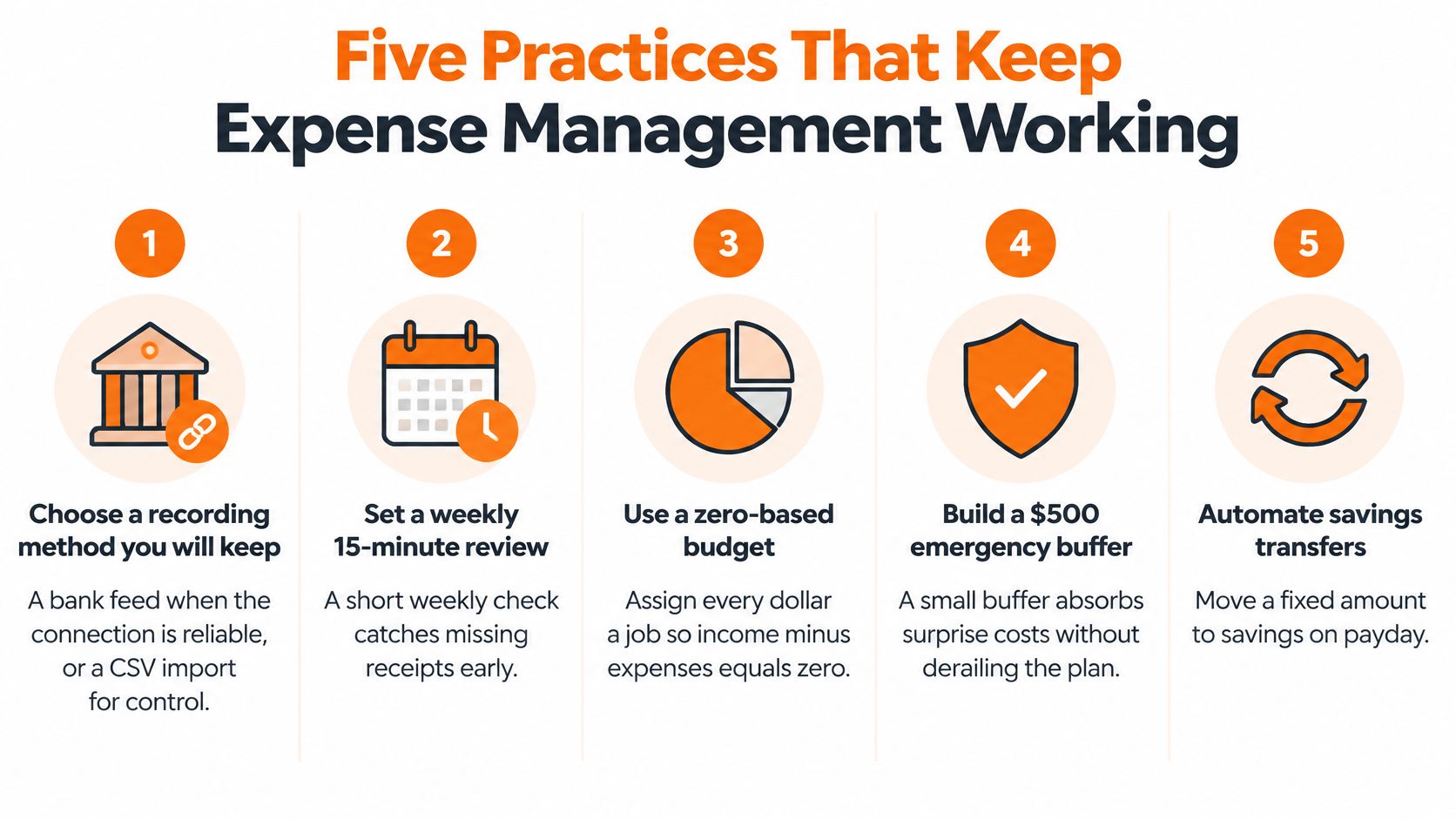
Most expense systems fail for boring reasons. They're too detailed, they're reviewed too rarely, or they ask for effort the person can't sustain in a busy week. These five practices are the ones that survive contact with real life.
Choose a recording method you'll keep. A bank feed is easiest when the connection holds, though connections do break and leave gaps. A CSV import handles a month or a year of past statements in one pass. Manual entry covers the rest. Plenty of households need manual entry at least some of the time, especially in Canada, where direct bank connections are less reliable than people expect.
Book a 15-minute weekly review in your calendar. Same day each week, same short window. Sit down with the category totals, ask what looks off, and close the laptop. A weekly rhythm catches missing receipts while you still remember the purchase.
Spread irregular bills across the year. A $1,200 annual insurance premium is $100 a month. Set that aside monthly and the bill stops being a shock in the month it lands.
Track cash-flow timing, not just totals. Note when pay arrives and when each bill is due. A bill that debits on the 1st is harmless if you know it's coming and painful if you don't.
Set one limit per variable category and watch the pace. A $300 dining limit means $75 a week. If you've spent $180 by the 10th, the total won't tell you anything yet, but the pace will.
The most common failure is trying to track everything in week one. People enter every receipt for four days, miss a weekend, feel behind, and quit by week three. A shorter, duller routine that covers 80% of transactions and runs every week beats a perfect system that runs for a fortnight. If you want a narrower starting point, this guide to tracking monthly spending builds from a single month's data.
Misconceptions and Limits of Expense Management
Misconception one: expense management is mostly about cutting spending. That advice assumes the problem is discretionary. For many households it isn't. During the recent affordability squeeze, Statistics Canada found the lowest income quintile saw much smaller income gains than the highest, $950 versus $6,099 in the comparison, while the share of Canadians reporting financial difficulties rose from 18.6% in 2021 to 32.8% in 2024, as reported in Statistics Canada's summary of household finances.
For a lower-income household, a review should answer a different question. Is the gap caused by spending habits, or by income set against essential costs? Those two problems need opposite responses, and only a clear record tells them apart.
Misconception two: an alert is financial advice. An alert flags an anomaly, like a possible duplicate charge or an unrecognized renewal. It doesn't tell you whether to cancel, dispute or ignore it. That still needs context and a rule for what to handle first. Nor is more budgeting always the missing piece: FP Canada's 2025 Financial Stress Index found paying bills and expenses was the leading financial concern for 37% of Canadians, while only 30% said creating a budget was an action that would help.
Misconception three: more tracking always helps. If the weekly review takes longer than the decisions it produces, the system is too detailed. Cut categories, not the habit.
If a review doesn't change a decision, you're collecting data, not managing money.
Test your setup against a real shock. Say the rent rises. Sort expenses into controllable (dining, subscriptions), negotiable (internet, insurance, phone plan) and unavoidable (rent itself, utilities, loan payments). A scenario budget then shows whether the gap closes with cuts, with more income, or with a change in the timing of payments. Running that exercise once teaches you more than reading three articles about budgeting.
Start Your First Expense Review This Week
Saturday, the grocery receipt is still in your coat and the chequing balance looks thinner than it did on Monday. You don't need a full year of history. One month is enough to find patterns, and one week is enough to start.
Tracking writes down what left the account. Management checks whether a thin week comes from extra spending or from costs you can't easily cut.
- Pull the last 30 days of transactions. Use a bank statement, a CSV export, or a handwritten list. Include everything, even the small purchases you're tempted to leave out.
- Build your first 8 to 12 categories. Give each one a broad label and, where it helps, a subcategory. Mark each as fixed, variable, or discretionary so a shortfall is easy to interpret later.
- Pick one limit to watch this week. Dining out at $100 for the week is a good starting point, because it's visible, adjustable, and usually where the drift shows up first.
In 2024, 91% of Canadians said they'd taken at least one action to reduce financial stress during the previous year, according to FP Canada's 2024 Financial Stress Index.
When you're ready to move past a spreadsheet, Fintrack's Transactions AI can categorize entries and answer plain-language questions about your spending, and the Free plan includes manual expense tracking and CSV imports, so you can start with whichever suits your records. For the thinking that sits on top of the record, the guide on benefits of spend analysis is the natural next reading.
Fintrack brings your income, expenses, budgets and goals into one dashboard, so the record you just built keeps answering questions long after the first month. Ask Finny what you spent on groceries, watch velocity alerts warn you before a category overshoots, and set limits you can track in real time. Visit Fintrack when you're ready to turn this month's review into a habit that runs on its own.